Minutes Back From Every Consultation: Bringing AI Summaries to Dutch Hospitals
Written by Andrea Rossi.
What we learned shipping our first AI feature in healthcare, and why we’re about to take it further.
You finally made it to your doctor’s appointment. After weeks of waiting, this is your moment to explain what has been bothering you. But while you talk, your doctor is typing away, and somewhere in the back of your mind a thought creeps in: are they even processing what I’m saying? Should I slow down so they can catch up?
You’re not imagining it. A big share of a doctor’s time for every consultation goes into documentation, and that time comes straight out of the conversation with you.
At ConsultAssistent we work on giving that time back to doctors. That’s why one year ago, we developed our first AI-powered feature: AI summaries of consultation reports. Before I get into what we’re building next (there’s a bigger article coming on that), I want to tell the story of what we achieved so far and what it took to ship it responsibly in a hospital setting.
How ConsultAssistent prepares the consultations before the doctor walks in?
When a hospital or clinic schedules an appointment, ConsultAssistent handles the patient communication: invitations, reminders, and smart questionnaires that the patient fills in online, at home, before their visit at the hospital or clinic. The questions are the ones a doctor would otherwise have to ask at the start of the consultation, about symptoms and how long and how severe they have been, medication use, medical history, and so on.
I say “smart” because the questionnaire adapts while the patient answers it. So that only the relevant questions get asked, the rest are skipped. For example, if you answer “no” to shortness of breath, you won’t get ten follow-up questions about it. This way the patient spends less time filling the questionnaire in, answers questions relevant for their situation and the doctor gets a cleaner picture, which he or she can process faster.
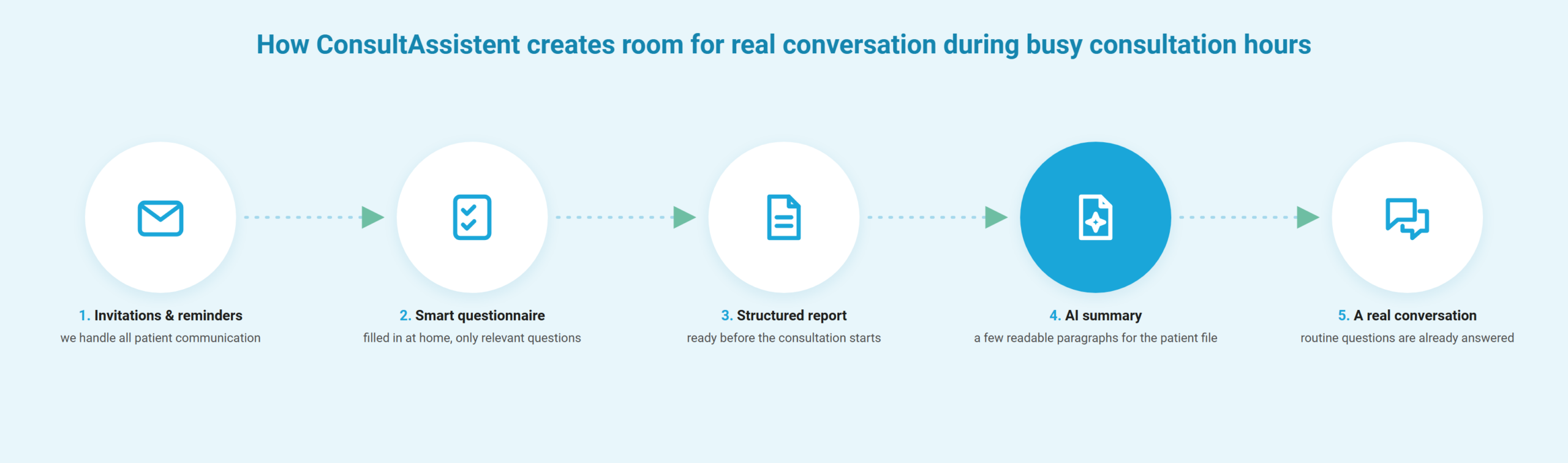
From those answers we generate a structured medical report and deliver it to the doctors and nurses who need it, before the consultation starts. The doctor walks in already knowing the patient’s story, can prepare in advance if something stands out, and doesn’t have to spend consultation minutes on routine and administrative questions. Thanks to this the appointment becomes more of an actual conversation.
After the report is ready, how can ConsultAssistent help save more time?
Our reports are built on a template system that we’ve refined over the years together with doctors from partner hospitals and the medical professionals on our own team. Different answers from the patient trigger the creation of different report sections.
Our users are very happy with the quality of our reports. But a good medical report has to be complete and should be dense and schematic. That works well for preparing a consultation, not for the patient file. There, doctors need the opposite: a short summary of a few readable paragraphs, easy to skim.
Until recently they typed those by hand, during or after every single consultation, and that time adds up after a full day. The problem was clear: we had automated the generation of the report from the questionnaire, but the summary was still manual work.
Turning dense, structured information into a few clear paragraphs happens to be something large language models (LLMs) are really good at. We’re not asking the model for medical judgment here. We’re asking it to save the doctor some typing.
AI summaries save 2–4 minutes per consultation
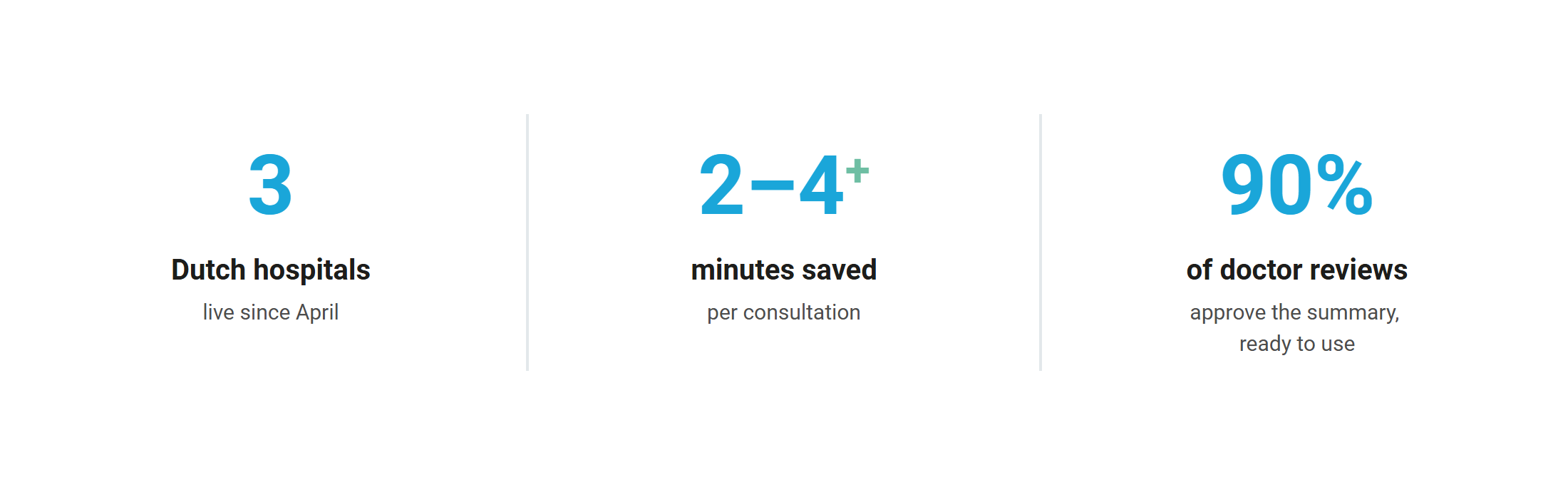
In April our AI summaries went live in three Dutch hospitals. The feedback from doctors is encouraging: in 90% of the reviews we received, the summary was approved and ready to be used.
The impact: doctors save at least two to four minutes per consultation, depending on the type of consultation. If you work outside healthcare, two to four minutes might not sound like much, but consider that most consultations are roughly ten to twenty minutes long. We gave doctors back around 20% of it!
And this is not about squeezing extra consultations out of the same day. Dutch healthcare is already stretched: care workers spend about 30% of their time on administration, a figure the government wants to bring down to 20% by 2030, and without additional measures the sector is heading for a shortage of around 300,000 workers by 2035. Every administrative minute we remove works in that direction.
Those minutes are not really ‘saved’ anyway, they change shape. The doctor stays present during the conversation, without the rush and the context switching of note taking, and with the mental space to ask the right questions (and yes, sometimes they simply become a coffee break that finally gets taken). On the other side of the table, the patient gets to look their doctor in the eye and talk about what is really bothering them, instead of feeling like they are dictating symptoms into a file. They get to feel heard.
On a personal note, these days everyone has an example of AI applied badly: features that make us think twice about our privacy, or wonder if it was really necessary to add it to a refrigerator. Well, as a software engineer, getting to apply AI in a way that gives people time and attention back is very rewarding.
Making AI hospital-proof: four design principles
Generating a summary with an LLM is the easy part nowadays. The hard part is embedding AI inside a hospital flow while guaranteeing high quality.
You can’t move fast and break things in healthcare, patients are on the line. And trust doesn’t get many second chances, because a doctor who sees one bad summary will think twice before relying on the next one.
But we were not starting from zero: years inside hospital workflows, side by side with doctors, had already taught us how to approach this. Four principles guided our design:
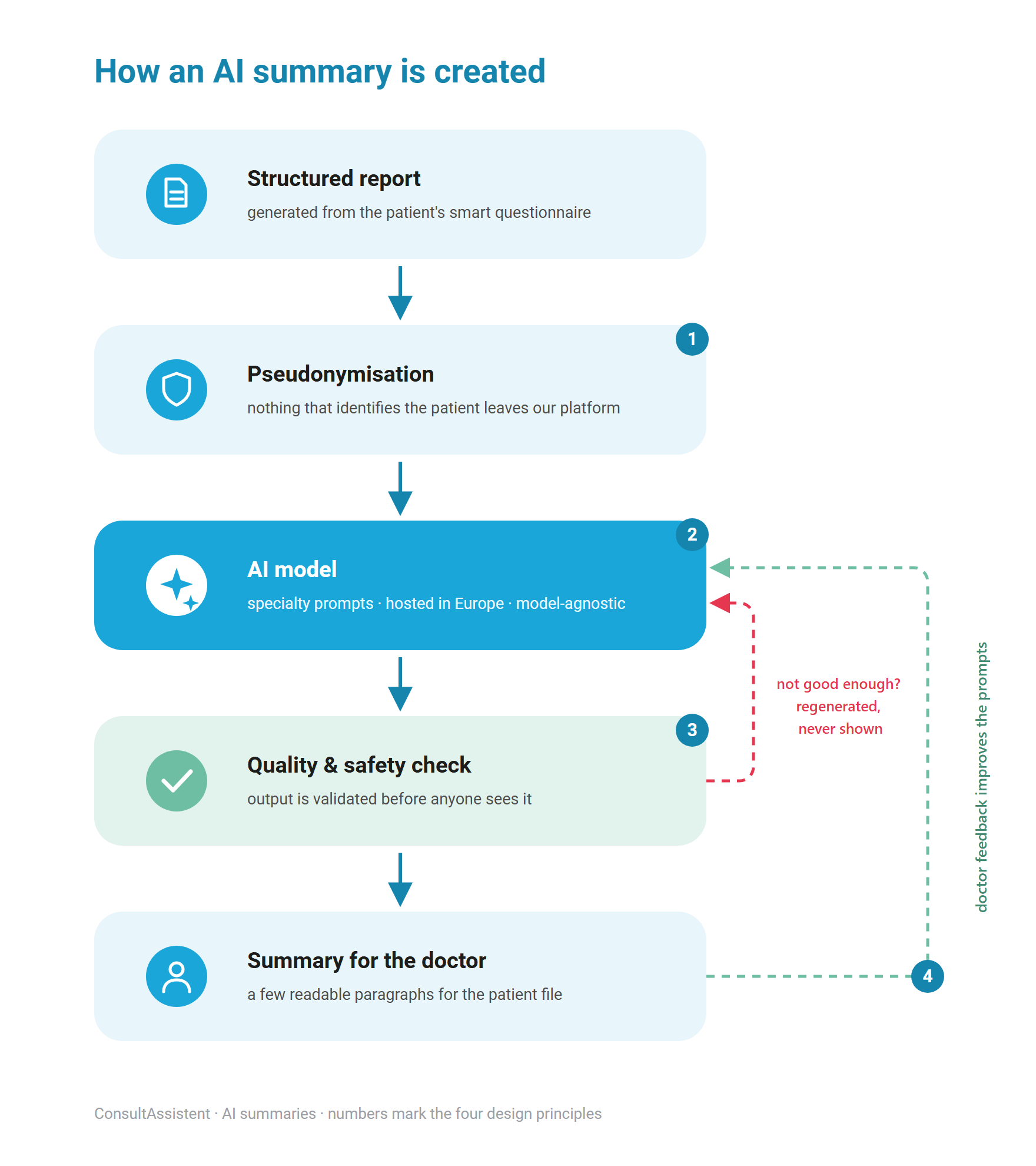
1. Privacy comes first, literally. It is the first stage of our pipeline. Before a report leaves our platform, a pseudonymisation step strips out all personal details: the model receives the medical content plus the minimal clinical context it needs, and nothing that directly identifies the patient. Everything runs on infrastructure hosted in Europe, in the Netherlands.
2. Every specialty is different. This is where the input from the doctors begins. An ENT specialist and a breast surgeon want different things highlighted in a summary so we allowed to tailor the summaries per specialty, and we developed and tuned them together with the doctors who use them. At the moment of writing we cover the Breast Clinic, ENT, Cardiology and Proctology departments, and will soon go live with summaries for Gynaecology and Gastro-Enterology.
3. Failures should be invisible. This is how we protect the hospital workflows, and the doctors’ trust with them. Summaries are generated asynchronously, fully decoupled from the flows hospitals depend on. If generation is slow, fails, or the output doesn’t pass our quality and safety checks, the doctor simply doesn’t see a summary yet: the system retries in the background. Anything suspicious is rejected and regenerated, because a doctor should never be the one to discover a broken AI output.
4. Every summary is a chance to learn. The doctors’ reviews close the loop. Doctors can rate and give feedback on each summary they receive, and we built tools to evaluate the impact of different prompt versions. When we change something, we don’t have to guess whether the summaries got better: we measure it, with the people who read them every day.
What’s next: how to improve quality further?
At ConsultAssistent we keep coming back to the same question: how do we save the precious time spent in healthcare, help doctors be more effective, and support patients through their journey?
AI is opening real possibilities in healthcare, and applying it safely is where our experience counts: we know the clinical workflows, the data constraints, and what doctors will and won’t trust. AI summaries were our first step, and we already know where they can get better.
Everything we learned this past year is feeding into the next one. We’ve been building a more advanced AI pipeline that goes beyond single-shot generation, with dedicated quality stages along the way, plus an evaluation framework so that every improvement is measurable, safe and repeatable.
But that deserves its own article, so we’ll save the details for the next post. 🙂
If you want to follow along, we’re on Medium and LinkedIn. And if you’re curious about who we are: consultassistent.nl/en/about-us.
ConsultAssistent helps hospitals and clinics save time on patient communication and preparation, so doctors can focus on what matters: the patient.