From Scores to Outcome-Based Care: How Visualizations Make the Impact of Care Visible
In healthcare, we are increasingly using metrics, but we are far from always making the most of them. Often, outcomes remain isolated figures or averages, lacking context and any connection to the care process.
AtConsultAssistent, we track many metrics from the start of the care journey (baseline) through to the follow-up. With the right visualization, this data becomes not only transparent but also actionable to support decision-making.The goal: to show at a glance where care is making an impact and where there is still room for improvement.
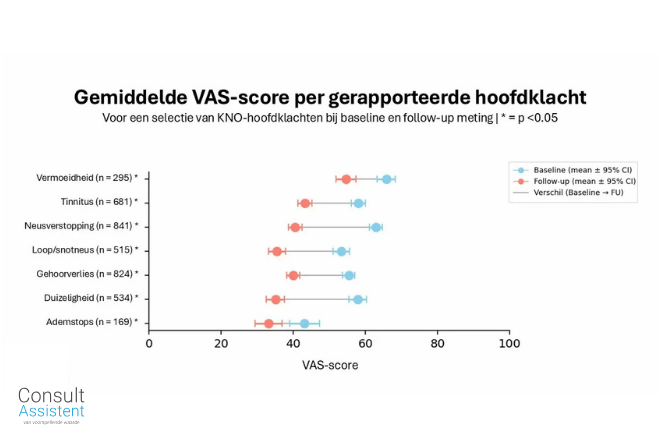
A concrete example: VAS scores in our ENT module
TheVisual Analog Scale (VAS)is a simple way for patients to indicate, for each symptom, how severe they perceive it to be (on a scale of 0–100).
In the visualization, we bring together:
🔷 The experience of symptoms at the start of the care process (baseline)
🔷 The change in the experience of symptoms following the care provided
🔷 Whether that change is statistically significant
What are the benefits?
➡️ Identifying frequent and severe symptoms: high baseline VAS scores reveal what patients are truly struggling with. This can help withplanning care capacity.
➡️ Highlighting the impact of care: Which symptoms improve significantly, and where is improvement lagging? This provides insights forprioritizing care.
➡️ Understanding trends and residual symptoms: Gaining insight into where symptoms persist. This can helpoptimize care pathways.
From Insight to Outcome-Based Care
The beauty of this approach is that itisn’t tied to a single type of score. Whetherit’s VAS scores, questionnaire items, or other outcome measures, the same analysis makes the impact of care visible and comparable.
Consider applications such as:
🔷Comparing treatments, healthcare facilities, or healthcare providers.
🔷Deepening the conversation in the exam room by comparing individual patients to the average.
🔷Targeted improvements in care from the patient’s perspective or in terms of effectiveness.
In short: the focus is shifting from recording to understanding, and data is becoming a tool for driving outcome-based care.