Less research during the cardiology consultation
A cardiology consultation requires time for assessment and decision-making. If basic information is missing, consultation time is wasted on asking questions again and organizing the information. This increases the administrative workload during office hours.
Practice at the Cardiology Outpatient Clinic
During consultations, a lot of time is wasted on:
- Incomplete or fragmented reference information
- Asking Routine Questions
- Asking about complaints, medical history, and the patient's request for help
- Verifying Medication Use
- Manual Organization of Patient Information
- Calculating Scores Manually
- Reporting in the EPD
As a result, the consultation often begins with a review of basic information, rather than with a focused assessment of the cardiovascular problem.
With ConsultAssistent's automated medical history form
The consultation gets to the heart of the matter more quickly:
- Advance Medical Directive
- Triage is being better supported
- The intake process is standardized and comprehensive
- Consultations begin with a comprehensive understanding of the patient's situation
- Potential to reduce the number of follow-up visits
- Remote Patient Monitoring
- Data for Research and Decision Support
Learn more about ConsultAssistent's digital medical history form.
Initial complaints within the cardiology module
The cardiology self-assessment is available to the entire patient population and supports, among other things:
Palpitations
- Heart palpitations
- Beats of the Heart
- Heart Skips a Beat
Chest pain
- Chest pain
- Chest pressure
Dyspnea
- Shortness of breath
- Shortness of breath
Presyncope
- Dizziness
- Feeling faint
Syncope
- Fainting
- To lose consciousness
Edema
- Fluid retention
The question flow adapts to the selected initial complaint and previous answers, so that only relevant questions are asked.

Thanks to ConsultAssistent's AI summary of the patient's medical history, I'm quickly and thoroughly prepared for a new consultation, and I have more time and attention to devote to the patient.
The Care Pathway in Cardiology
ConsultAssistent supports the care pathway before, during, and after the cardiology consultation.
Before the consultation
The patient completes the digital self-assessment at home based on the reason for referral and the presenting complaint. Depending on the care pathway, questions regarding cardiovascular history and risk factors follow. Questions may also be asked about family history, functional capacity (MET score), cases of poisoning, and medication use.

During the consultation
The cardiologist has a structured overview of:
- Symptoms and Course of the Disease
- Medication Use
- Medical History
- Family History
- Cardiovascular Risk Profile
During the consultation, the cardiologist reviews the structured report in the EHR. The cardiologist evaluates the AI summary and uses it as the basis for their own report. The cardiologist remains responsible for the interpretation and decisions.

After the consultation
Personalized follow-up and cardiology outcome measures can be used to monitor symptoms and functional capacity.

Curious to know how this works in your cardiology practice?
Demo requestMonitoring Cardiovascular Outcomes Over Time
Outcome data provide the care team with additional information about changes in symptoms and functioning. Where this feature is enabled, the cardiology module collects data at agreed-upon measurement points, such as:
- Patient-Reported Outcome Measures (PROMs) for Cardiology
- Repeated measurements of symptom burden
- Follow-up on Functional Capacity
- Trend Display Over Time
- Overview at the patient and population levels
The outcome data show changes for each patient over time. The care team uses this data as supplementary information when evaluating the care pathway.
The data can also be made available for the preparation of multidisciplinary consultations, such as heart team meetings.
At the department level, the results provide additional information to support the hospital’s quality policy.
PROMs and Outcome Measures in Cardiology
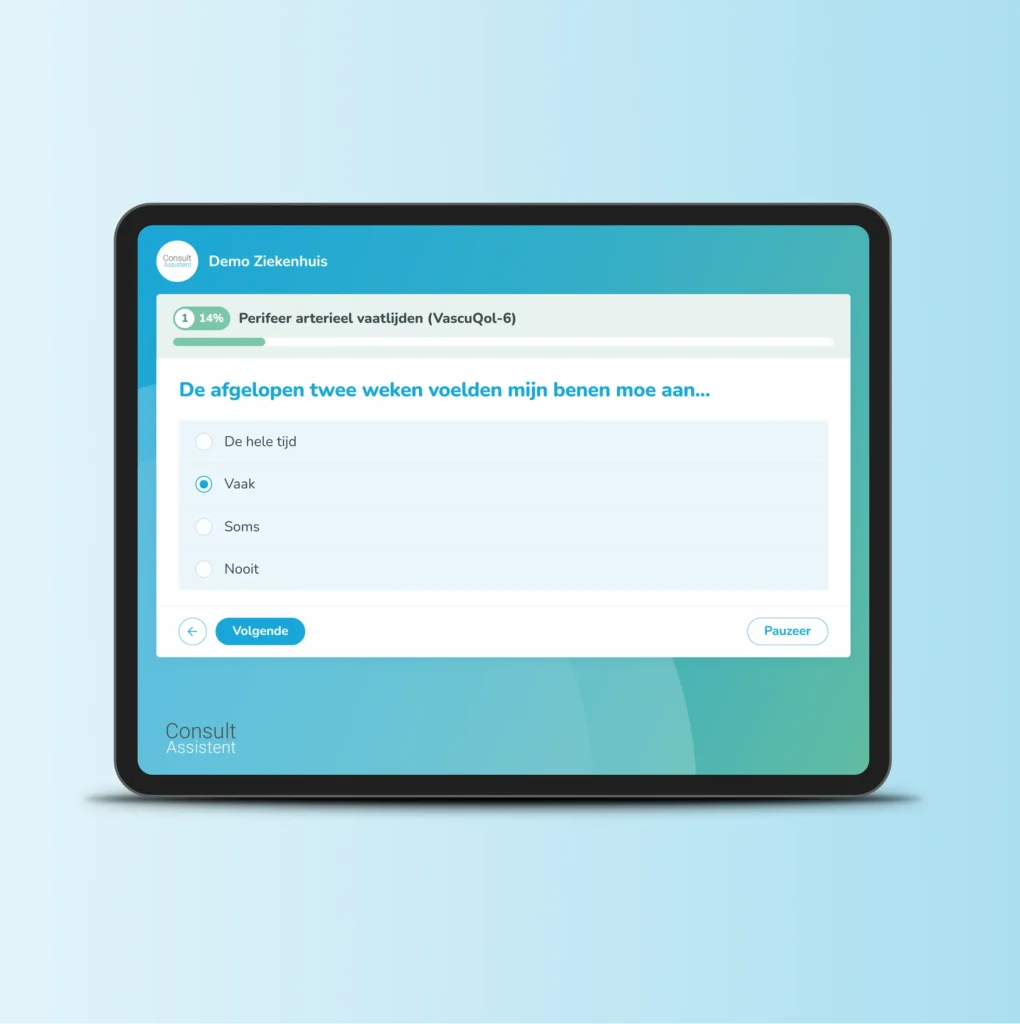
PROMs provide insight into how patients experience their symptoms and functioning. Depending on the facility, the following questionnaires and outcome measures, among others, are available:
- Seattle Angina Questionnaire
- VEINES-QOL
- Peripheral Artery Disease (DICA)
- Quality of Life in Atrial Fibrillation (ICHOM)
PROM questionnaires can be part of the self-reported medical history or follow-up process, or they can be sent separately at an agreed-upon time. This provides the care team with information about symptoms and functioning when it is relevant. If the desired PROM questionnaire isn’t listed, we can easily add it.
Value for the Cardiology Practice
- Routine questions asked digitally in advance
- Consultations begin with structured patient information
- Overview of Symptoms, Medications, and Risk Factors
- Follow-up questions at scheduled check-in times
- A Single Information Base for the Cardiology Team
- Trends in Outcomes Over Time

Frequently Asked Questions About the Cardiology Module
How long does it take to complete the ConsultAssistent digital cardiology questionnaire?
The time it takes to complete the questionnaire varies by patient and depends on the initial complaint and previous responses. The adaptive questionnaire skips questions that do not apply to the situation. As a result, the length of the questionnaire also varies by patient.
Can we add specific cardiology classifications?
Yes. Together with the department, we determine which cardiological classifications are appropriate for the care pathway. These may include, for example, the EHRA classification and the MET score, depending on the facility. The cardiologist reviews the classification or score before it is used.
How is medication use recorded?
Medication use is systematically recorded in the EPD report so that this information is immediately available during the consultation.
Does the module support repeated cardiology outcome measurements?
Yes. Where this system is in place, symptom scores and PROMs can be collected again at agreed-upon times. The care team reviews the results and changes over time.
Can the digital medical history form be adapted to our care pathway?
Yes. We work with the department to set up the questionnaire process, report format, and assessment points so that they align with the cardiology care pathway and existing procedures.
Get in touch
Curious about how ConsultAssistent can help with consultation preparation and outcome measurement in your cardiology department? Give us a call or send us an email. We’d be happy to work with you to develop your care pathway and workflow.