From time-consuming medical histories to targeted consultations
Preparing for Consultations in an Orthopedic Practice
There are several challenges within the orthopedic practice:
- Long wait times and high patient volume
- Many patients with chronic conditions (e.g., osteoarthritis)
- Frequent postoperative follow-up visits
- The nature of the request for help is often unclear from the outset
- Time-consuming medical history-taking with standard questions
- A lot of paperwork and repetitive work
As a result, consultation time is not used optimally.
Preparing for an appointment with ConsultAssistent
Better consultations thanks to thorough preparation:
- Patient Information Collected in a Standardized Manner in Advance
- Assessing Mobility and Symptoms Before the Consultation
- The patient's request for assistance is known in advance
- Consultations begin with a comprehensive assessment
- Work More Enjoyably and Easily
- More time for the patient
Learn more about ConsultAssistent's digital medical history form.
Initial complaints in the orthopedics self-assessment module
The orthopedics patient history module has a wide range of applications in orthopedic care. Currently, the module supports, among other things:
- Knee Problems
- Hip Problems (in progress)
- Shoulder Problems (in progress)
- Outcome Measurement Using PROMs
The questions adapt based on previous answers, so that only relevant follow-up questions are asked.
Digital Medical History for Orthopedics
In orthopedics, it is important to link symptoms to functional limitations. Digital automated medical history-taking provides insight into this.
Patients fill out information about their symptoms in advance. A unique feature of the orthopedics module is that patients can indicate their range of motion through interactive visual questions. This provides a concrete picture of their mobility even before the consultation.
The digital vehicle history includes, among other things:
- Structured Medication Inquiry
- Orthopedic History
- Assessment of Symptom Burden (VAS)
- Interactive visual feedback of range of motion
- Reason for Seeking Help and Treatment Outlook
The data is automatically processed into a structured report in the EPD and supports the assessment during the consultation. In addition, a medical AI summary ready for use during the consultation is available. The healthcare provider reviews the AI summary and remains responsible for documentation and decision-making.
The Orthopedic Care Pathway
ConsultAssistent supports the care pathway before, during, and after the consultation.
Before the consultation
The patient fills out the self-administered medical history form in advance. The form asks not only about symptoms, but also about mobility, pain levels, and the need for assistance.

During the consultation
The orthopedic surgeon has a structured overview of:
- Symptoms and Course of the Disease
- Pain Score (VAS)
- Mobility and Range of Motion
- Medication Use and Medical History
The visual representation of movement reduces the need for interpretation and speeds up the assessment.

After the consultation
Outcome assessments and follow-up are used to monitor recovery and treatment, for example, after surgery or in cases of chronic symptoms.

Curious to know how this works in your orthopedic practice?
Demo requestInsights into Patient Data and Outcomes
The collected data is automatically processed into a structured report in the EPD and can also be displayed in clear dashboards that provide insight into complaints and outcomes.
This makes it possible to:
- Tracking Recovery and Mobility Over Time
- Monitoring Treatment Outcomes
- Supporting Decision-Making with Data
In the field of orthopedics, this contributes to a better understanding of functional recovery and treatment outcomes. The collected data can also be used to compare treatment outcomes and further improve care processes.
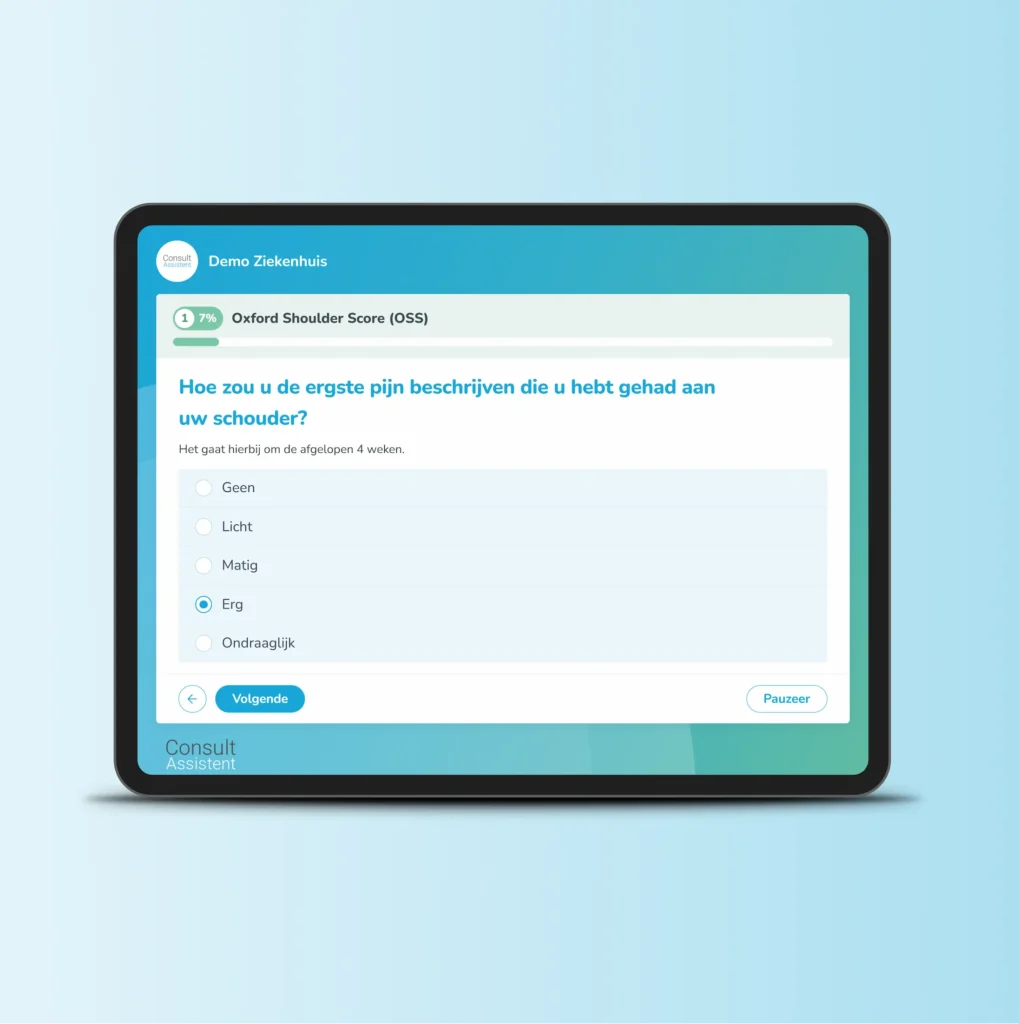
PROMs and Outcome Measures
in Orthopedics
The orthopedics module includes the following:
- KOOS-PS (knee)
- Oxford Shoulder Score
- PROMs for hip, knee, and shoulder replacements
Is your preferred PROM questionnaire not listed here? If not, we can easily add it. The PROM questionnaires can be integrated into the automated medical history or follow-up process, but they can also be sent separately at the right time—for example, before, during, and after treatments. This way, you’ll always gather the right insights at the moments that really matter.
How does this benefit the orthopedic practice?
- Spend less time on routine medical history taking
- More Efficient Consultations
- A Better Understanding of Mobility Before the Consultation
- More Targeted Triage and Treatment Selection
- Using Follow-Up Appointments More Effectively
- Better Monitoring of Recovery

Frequently Asked Questions About the Orthopedics Self-Assessment Module
How does digital medical history-taking help in orthopedic consultations?
Patient information is collected in advance, which reduces the time needed to ask about symptoms and mobility and allows the consultation to begin immediately with an assessment.
How is mobility visualized in the orthopedics module?
Patients can use visual scales to indicate their range of motion, giving the orthopedic surgeon insight into functional limitations in advance.
Can ConsultAssistent also handle the preoperative screening?
ConsultAssistent includes a preoperative screening module that provides the anesthesia team with insight into risk factors and enables them to determine whether an outpatient consultation is necessary.
How are PROMs used in orthopedics?
PROMs are used to measure symptoms, mobility, and outcomes before, during, and/or after treatment and during follow-up.
Get in touch
Curious about how ConsultAssistent can help with consultation preparation in your orthopedics department? Give us a call or send us an email. We’d be happy to work with you to develop your care pathway and workflow.