From a stressful intake to time for the real conversation
Practice at the proctology outpatient clinic
There are several challenges in the field of proctology:
- Appointments are often postponed due to embarrassment
- Complaints are not always fully described
- Long-term treatment plans with follow-up appointments
- A Lot of Communication About Treatment
- Physical examinations are time-consuming
As a result, patients sometimes enter the care process at a late stage, and treatment becomes more complex.
Preparing for an appointment with ConsultAssistent
Proctology appointments run more smoothly with ConsultAssistent:
- Patients fill out their symptoms in advance at their own pace
- A More Complete Picture Before the First Consultation
- Start Consultations with Better Preparation
- Better information provided before the consultation
- More time for sensitive conversations and explanations
Learn more about ConsultAssistent's digital medical history form.
Initial complaints in the proctology module
The proctology self-assessment is available to the entire patient population and supports, among other things:
- Rectal bleeding
- Anal Pain Symptoms
- Itching Symptoms
- Anal leakage
- Constipation
- Fecal incontinence
- Perianal skin flap
The questions adapt based on previous answers, so that only relevant information is requested.
Digital Medical History for Proctology
At the proctology clinic, patients often find it difficult to discuss their symptoms, and embarrassment plays a major role in this. By having patients answer questions in advance in their familiar surroundings, we can gain a more honest and complete picture of their symptoms.
Patients provide information in advance regarding:
- Symptoms such as pain, itching, or bleeding
- Bowel Movement Pattern
- Medication Use
- Medical History and Risk Factors
- Request for Help
This provides a more complete and reliable picture of the symptoms even before the consultation. This helps to focus the consultation directly on the core of the problem.
Real-World Case Study
HagaZiekenhuis
Dr. Ilse Jannink – Surgical Oncologist: "I now really miss it when a patient hasn't filled out the self-administered medical history form."


Ilse Jannink —a surgical oncologist at Haga Hospital —has been using a smart, structured approach to gather information from patients prior to their appointments since 2015. This results in a higher-quality consultation for both the doctor and the patient—according to Jannink: the patient quantifies the severity of their symptoms using scales and numbers, and the doctor already knows the patient’s medical history, family history, medication use, and the specific reason for the visit before the consultation even begins.
The response rate is high, even among older adults and non-Dutch speakers. The report from the pre-filled medical history form is complete, well-organized, and already available in the EHR before the consultation, allowing the consultation to get straight to the point. This leads to a better conversation and a more efficient consultation—I now really miss it when a patient hasn’t filled it out.
In many cases, the AI summary can be used immediately during consultations, saving a lot of typing—and therefore time. The team at ConsultAssistent is flexible, and the software is smart and quick to adapt, which makes it a pleasure to work with them. I also really appreciate that we own the data ourselves and can use it to conduct our own analyses and research.
So does better preparation for a consultation lead to a better consultation? Yes, I'm convinced of that.
The Proctology Care Pathway
ConsultAssistent supports the care pathway before, during, and after the consultation.
Before the consultation
The patient fills out the self-assessment form in advance. This provides insight into the patient’s symptoms, their duration, and their severity before the patient arrives at the clinic. It also allows for information about tests and treatments to be provided early in the process.

During the consultation
The surgeon has a structured overview of:
- Symptoms and Course of the Disease
- Medications and Medical History
- Risk Factors
- Request for Help
In addition to the structured report in the EPD, a concise AI-generated medical summary is also available that can be used immediately during the consultation. This saves surgeons time and further reduces the administrative burden. Furthermore, the patient is better prepared for the consultation. The healthcare provider reviews the AI summary and remains responsible for documentation and decision-making.

After the consultation
Follow-up and outcome measures are used to monitor symptoms and treatment, for example, in cases of chronic symptoms or after a procedure.

Curious to know how this works in your proctology practice?
Demo requestBetter insight into the course of treatment
Before, during, and after treatment, the patient is asked about their symptoms. The collected data is automatically processed into a structured report in the EHR and also entered into a research database.
This makes it possible to:
- Complaints regarding time to be followed up on
- Monitor the Effect of Treatment
- Use follow-up appointments in a more targeted manner
- Deciding Together on the Next Steps
By systematically documenting symptoms and outcomes, we gain insight into long-term treatment pathways and treatment results at the patient and population levels.
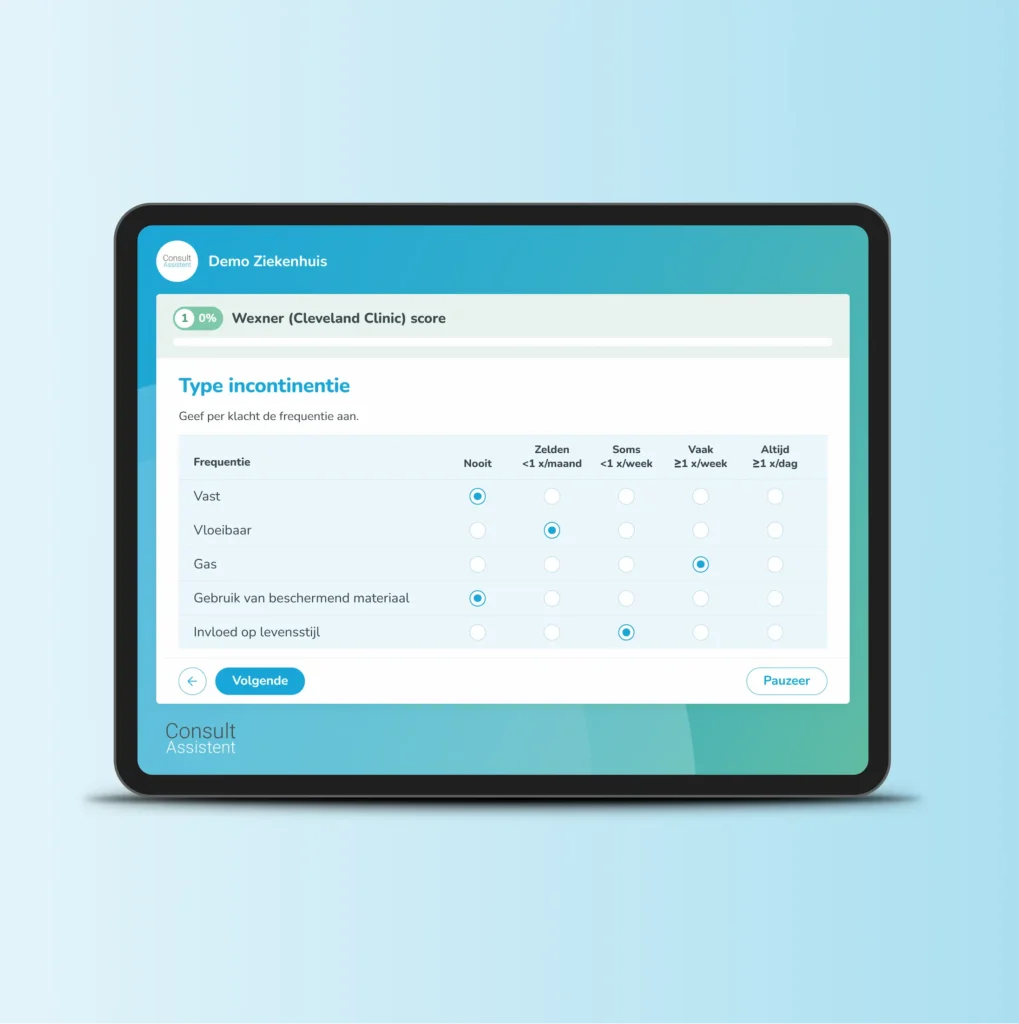
PROMs and Outcome Measures
in Proctology
The proctology module includes the following PROM, among others:
- Wexner Score
Is your preferred PROM questionnaire not listed here? If not, we can easily add it. The PROM questionnaires can be integrated into the automated medical history or follow-up process, but they can also be sent separately at the right time—for example, before, during, and after treatments. This way, you’ll always gather the right insights at the moments that really matter.
How does this benefit the proctology practice?
- A More Complete Medical History Before the Consultation
- Lower barrier for patients
- More Efficient Consultations
- Gaining a Better Understanding of Patients' Questions in Advance
- Spend less time on routine questions
- Better insight into the course of treatment
- Improved communication with patients

Frequently Asked Questions About the Proctology Module
How does digital medical history-taking help during proctology consultations?
Patient information is collected in advance, which allows for more time for sensitive conversations and enables the consultation to be immediately focused.
Does the digital questionnaire help patients who find it difficult to discuss their symptoms?
Yes, patients often provide more complete and honest answers when they can fill out the form digitally in advance in their own familiar environment.
Which symptoms can be assessed digitally in the proctology module?
These include pain, itching, bleeding, incontinence, and constipation. ConsultAssistent’s proctology self-assessment is available to the entire patient population.
Can digital medical history-taking help with long-term treatment plans?
Yes, because complaints are tracked over time, this provides a better understanding of the course of treatment and the effectiveness of treatments.