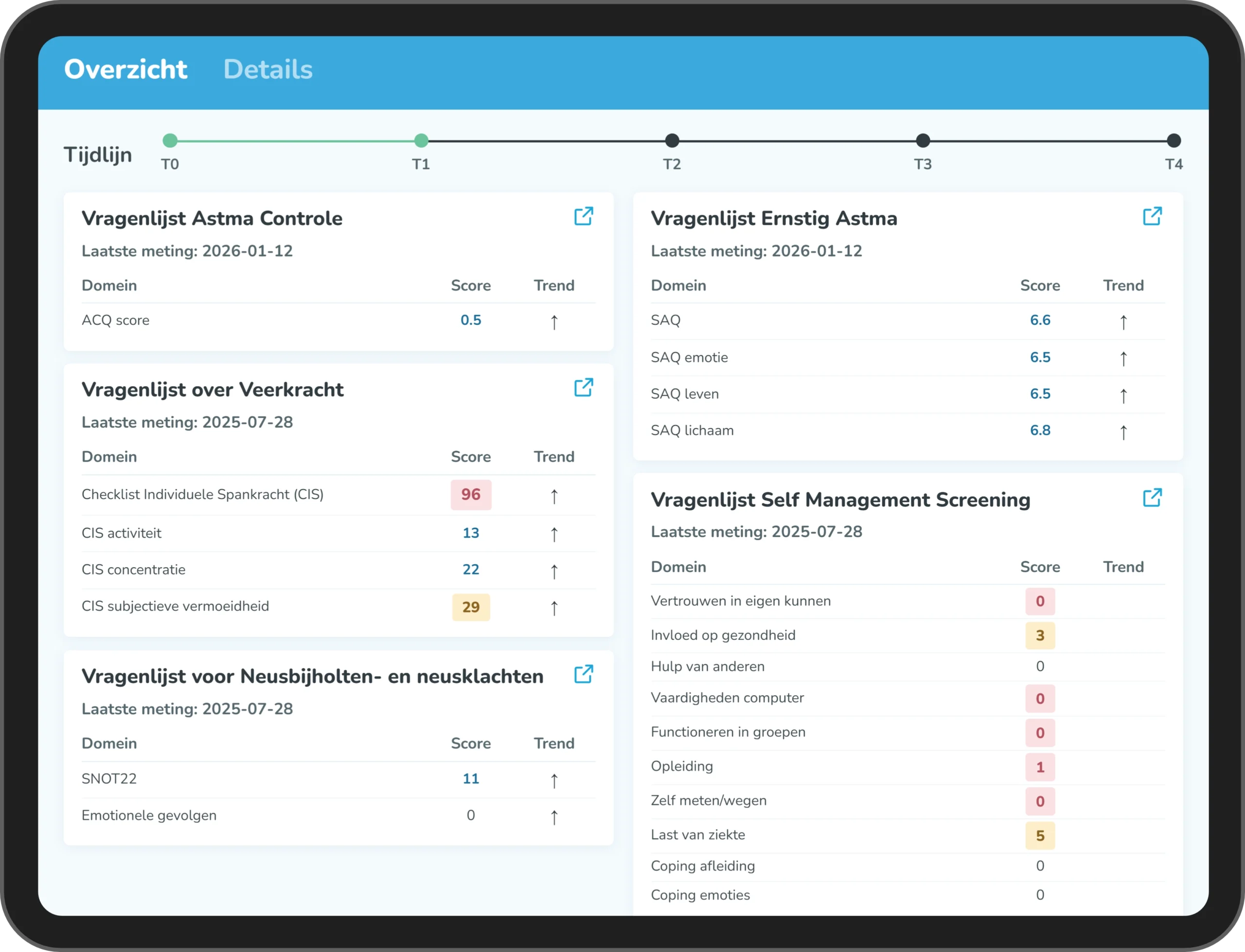
More targeted triage and patient selection
More structured patient information can better support triage. ConsultAssistent gives insight into the severity and nature of symptoms, flags risk factors, and supports patient prioritization. This gets patients to the right point in the care process faster and lets capacity be deployed more purposefully. It helps keep growing care demand manageable, and lets the same capacity serve more patients.
Better alignment of demand and capacity
Insight into the initial clinical presentation and care need makes it possible to steer capacity more effectively. Think of assessing urgency and required tests, insight into patient complexity and background, and support for planning and production agreements. This helps align care demand with available capacity, and contributes to shorter waiting times and more efficient use of care capacity.
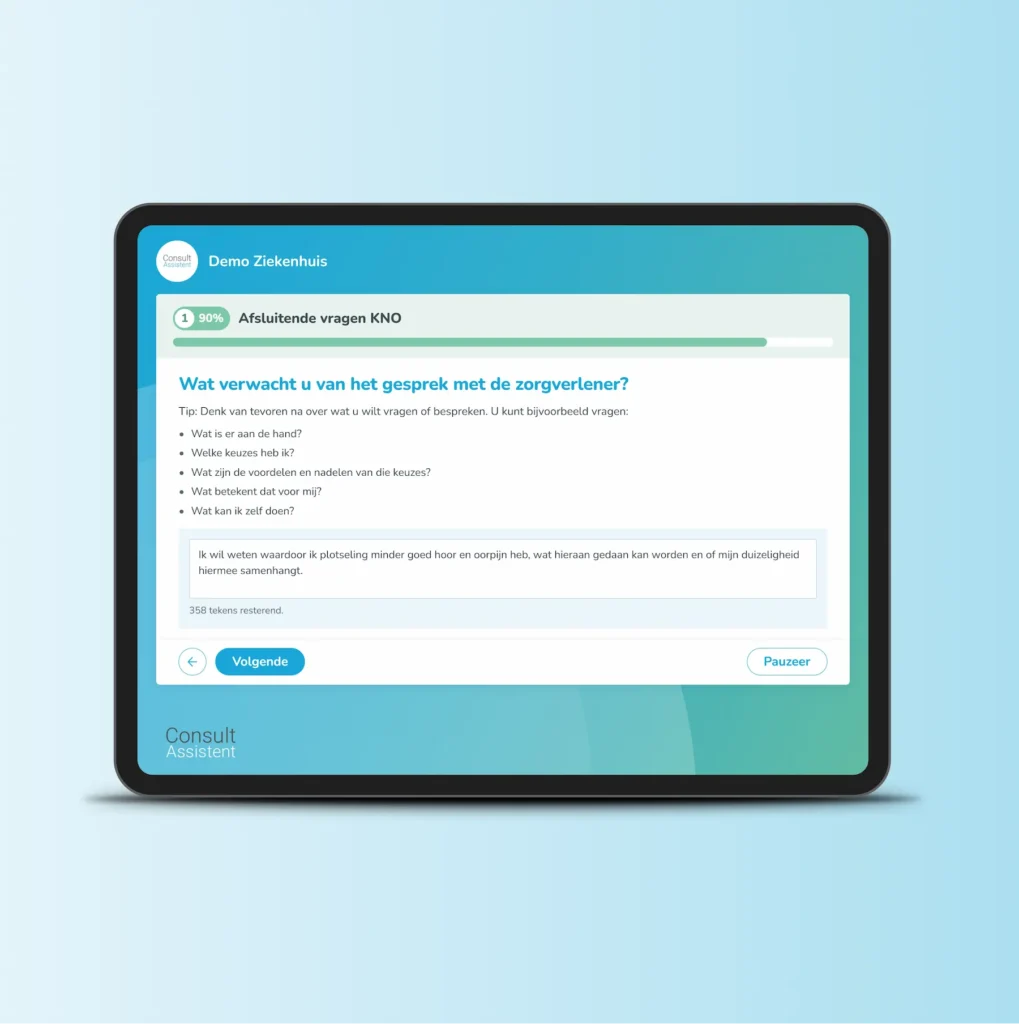
Understanding the patient's care needs before the appointment
During patient intake, the actual care need often only becomes clear during the consultation itself. Referrals contain limited information, symptoms are only asked about on the spot, and triage happens on the basis of limited information — sometimes on assumptions. That costs time and capacity.
ConsultAssistent makes it possible to collect patient information in a structured way beforehand. This surfaces the care need earlier, creating a better foundation for triage, planning, and accessible care.
Integrated decision support in practice
Based on the data it collects, ConsultAssistent develops smart forms of decision support. This helps healthcare providers make faster, better-substantiated choices. Examples of decision support include:
- Enriching referral information to support triage
- Flagging missing medical information or tests
- Signaling that a patient shows characteristics of a specific diagnosis
- Generating ready-to-use text for the patient letter
- Recognizing that symptoms have eased and a follow-up visit may not be needed
This support is low-threshold and directly applicable in daily practice.
See a wider variety of patients within the same number of slots.
The hospital called: I didn't have to go to the hospital for my follow-up appointment. That was great!
From data to insight to decision support
This falls under clinical decision support: using care data for analysis and substantiated decision-making. Combining digital auto-anamnesis, PROMs, and follow-up creates:
- A more complete patient picture
- Insight into patterns and deviations
- Better-substantiated decisions
This makes data not just visible, but usable for action.
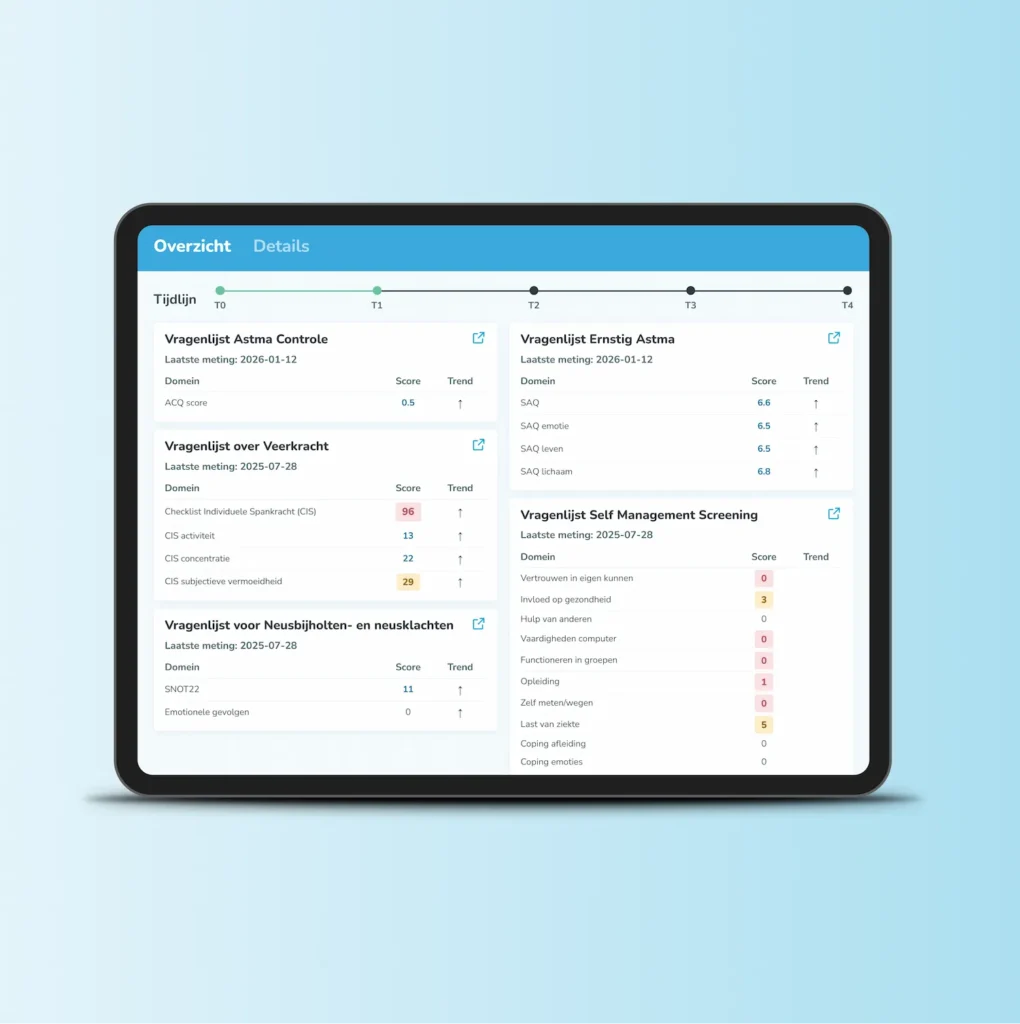
Support for value-based care
By combining outcomes and patient context and making them practically applicable, healthcare providers can:
- Tailor care to the patient
- Measure results and experiences
- Decide together with the patient
- Make better treatment choices
- Prevent unnecessary care
This supports the shift toward the right care in the right place, and facilitates value-based healthcare.
What does this deliver for your healthcare organization?
- Better substantiation of treatment choices
- Recognizable patterns in patient groups
- Better analysis of treatment outcomes
- Insight into process and practice variation
- Tools for improving care processes
- Better use of capacity
- Support for shared decision-making
- Insights for quality improvement

Data for accessible and affordable care
With our digital auto-anamnesis, follow-up, screenings, PROMs, and PREMs, we make it possible to collect structured care data while delivering smarter care at the same time. This helps care organizations meet growing care demand with a shrinking workforce.
Request a demo Get in touch
FAQ about decision and data support
How does decision support differ from standard reporting?
Decision support goes beyond just showing data. It helps flag and summarize relevant information so healthcare providers can reach a well-substantiated decision faster.
On what basis are signals and insights generated for decision support?
These insights are based on a combination of digital auto-anamnesis, PROMs, and follow-up data. Combining this data creates a more complete picture of the patient and how symptoms are developing.
Is AI used in decision support?
Yes. AI is used to structure and summarize information so healthcare providers get insight into relevant data faster.
Can digital follow-up help make follow-up visits more targeted?
Yes. The healthcare provider uses information about symptoms and recovery to judge whether an in-person follow-up visit is needed. This can free up room for patients who do need one.
Which care processes is decision support suited to?
Decision support can be used in diagnostics, follow-up, triage, and scheduling consultations. It supports both initial consultations and long-term care pathways.
Can decision support also be used at the organizational level?
Yes. the collected data can be used to analyze patterns, compare treatment outcomes, and improve care processes.
Get in touch
We're glad you're interested in ConsultAssistent. Do you have a question? Please contact us. You can reach us by phone or send us an email. We'd be happy to help you.