What is a digital auto-anamnesis?
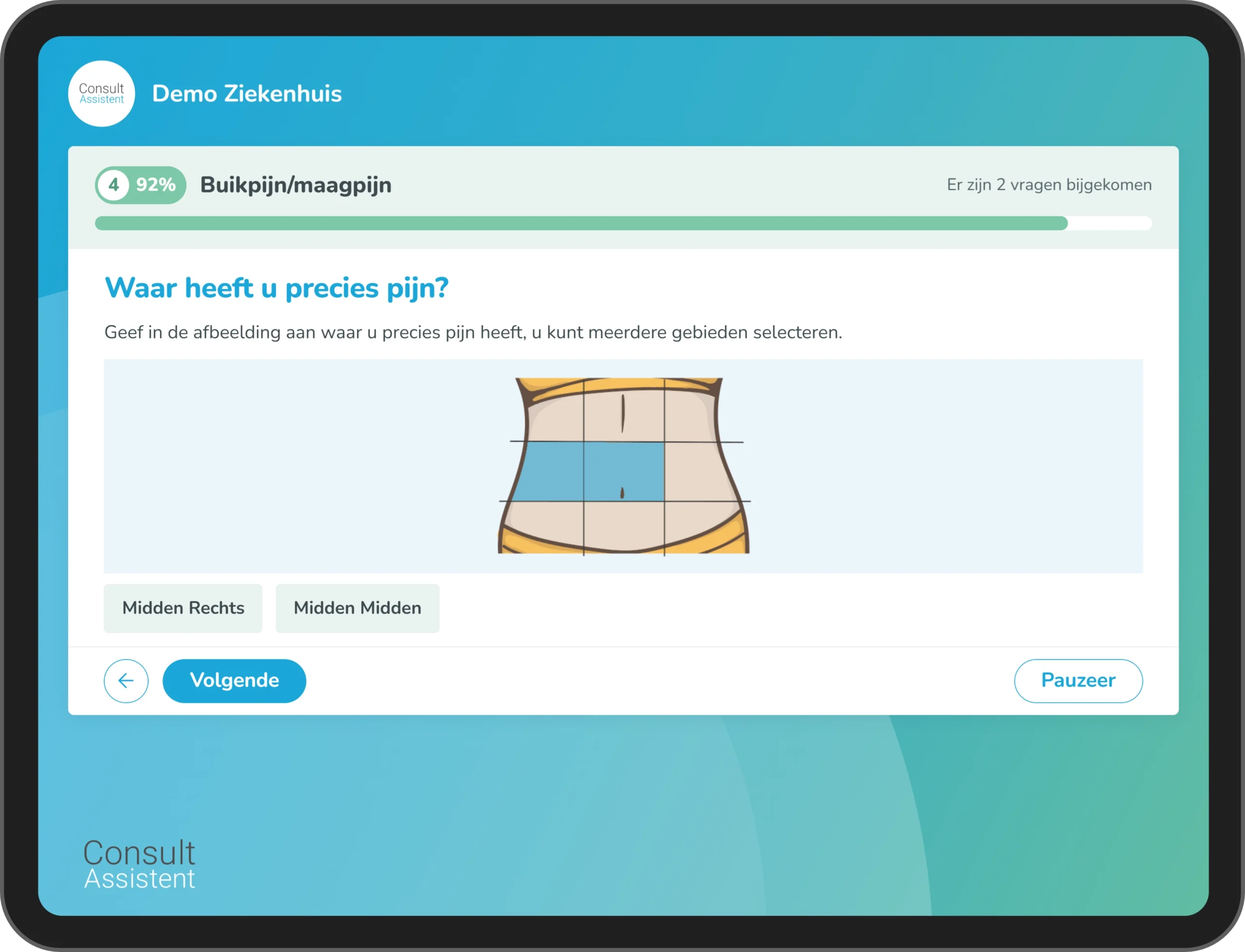
A digital auto-anamnesis collects medical information prior to a consultation. Patients answer adaptive questions about their reason for referral, symptoms, medication, medical history, family history, and presenting complaint. Follow-up questions build on what the patient has already answered. This creates a targeted set of questions tailored to the patient's specific situation.
Get to the heart of the matter faster with digital consultation preparation
Anamnesis in today's consultation practice
In many healthcare facilities, the anamnesis still takes place during the consultation itself:
- History-taking varies from doctor to doctor
- Symptoms only become clear during the consultation
- Medication and medical history are asked again
- Routine questions take up consultation time
- EMR documentation takes extra time
As a result, less time remains for deeper discussion, explanation, and shared decision-making.
Preparing for a consultation with ConsultAssistent
With digital auto-anamnesis, preparation already begins at home:
- The patient answers relevant questions in advance
- Symptoms and presenting complaint known in advance
- A structured overview from the start
- AI summary as the basis for a consultation report
- Room for deeper discussion and shared decision-making
The doctor and patient use consultation time for meaningful discussion and decisions.
Adaptive question structure
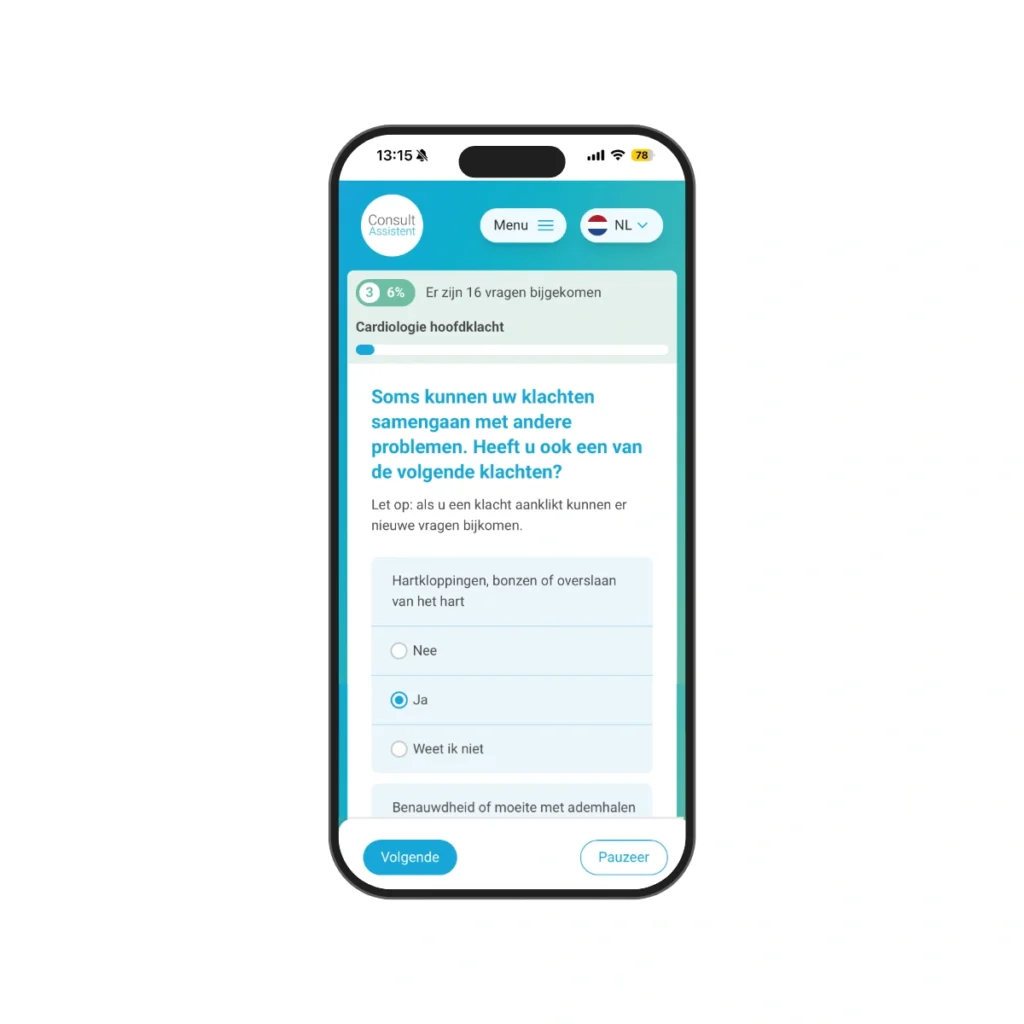
The digital auto-anamnesis tailors follow-up questions to the patient's profile, presenting complaint, and previous answers. As a result, each patient is only asked questions relevant to their own situation, keeping the questioning focused. The adaptive flow mirrors a natural anamnesis conversation, which helps keep patients engaged while completing it.
The digital auto-anamnesis may ask about, among other things:
- Duration and severity of symptoms
- Medication use
- Medical history
- Warning signs
- Functional limitations
- Presenting complaint and expectations
AUTOMATIC INVITATIONS
Invite patients automatically
Prior to the consultation, the patient automatically receives an invitation to complete the digital auto-anamnesis. If needed, ConsultAssistent also sends a reminder. Depending on the implementation, ConsultAssistent invites patients via:
- Patient portal
- Email or text message
- Hospital app
- BeterDichtbij
- Other healthcare apps
AI-supported EMR reporting
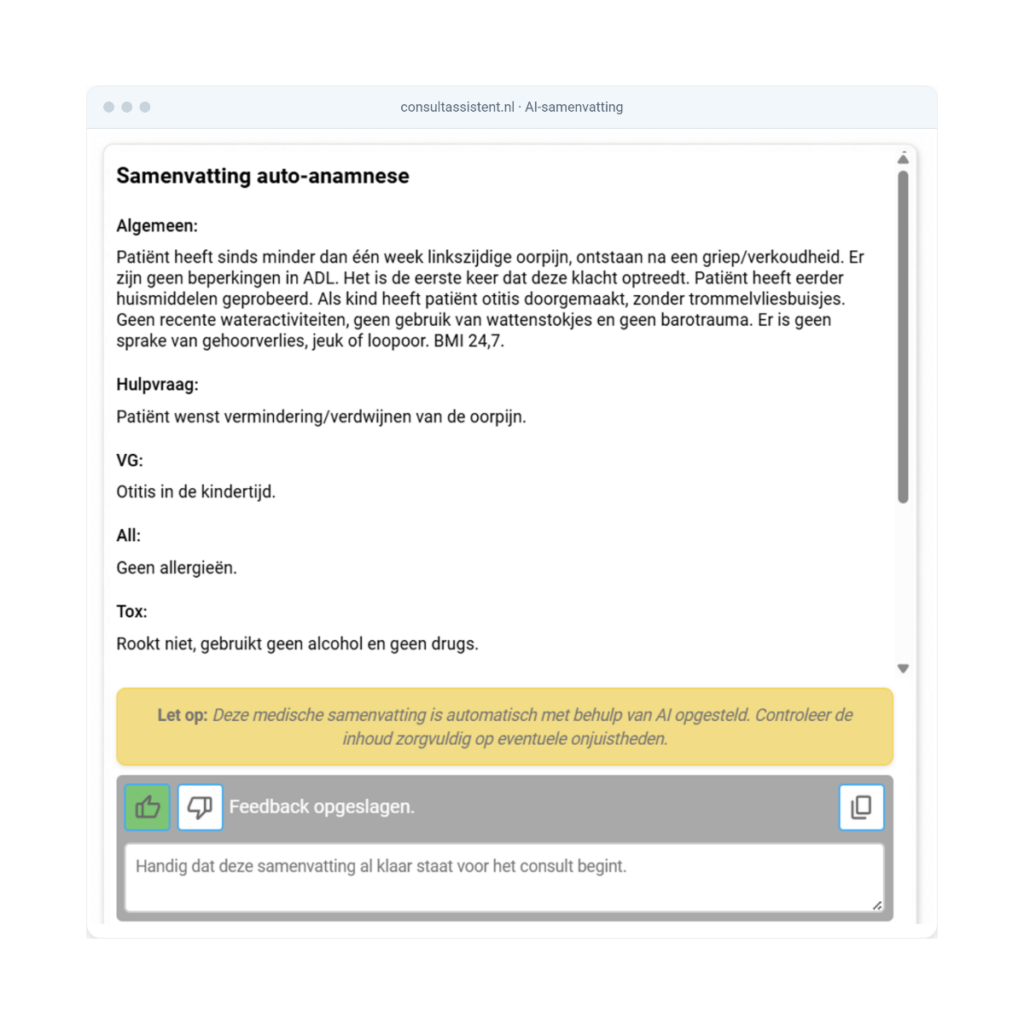
Before the consultation, the doctor receives a structured overview in the EMR. ConsultAssistent processes the completed digital auto-anamnesis into a report that includes, among other things, the presenting complaint, patient profile, symptoms, classifications and scores, medical history, and medication.
In addition, ConsultAssistent generates an AI summary in the format of a consultation report, with sections such as presenting complaint, medical history, family history, allergies, toxicology, and social circumstances. The physician reviews the summary and supplements it where needed. Only after approval is the AI summary added to the EMR, where the physician uses it as the basis for their own report. The physician remains responsible.
This leaves more time and attention during the consultation for the conversation with the patient, and ConsultAssistent supports documentation without taking over the professional assessment.

Since we started using ConsultAssistent, the way we conduct consultations has really changed. The most important information is available in advance, which allows me to get to the heart of the matter more quickly and gives me more time to talk with the patient.
From digital auto-anamnesis to targeted follow-up
Healthcare providers and patients can continue to track the progress of symptoms and treatment. After the digital auto-anamnesis, ConsultAssistent invites patients at scheduled times to answer follow-up questions and complete Patient-Reported Outcome Measures (PROMs). At the group level, the results provide information for improving care and for research.
What are the benefits of digital auto-anamnesis for healthcare providers?
- Patients better prepared for their appointments
- Less workload thanks to fewer follow-up questions and less typing
- More room for diagnostics and shared decision-making
- Earlier identification of presenting complaints and complex cases

STRUCTURED HEALTHCARE DATA
Structured healthcare data for quality and research
ConsultAssistent records answers in fixed data fields. The comprehensive, personalized questionnaire builds a structured dataset over time that includes relevant context, such as age, medical history, and lifestyle. Patients give explicit consent in advance for the use of their data for research. The data is available for research within the framework of applicable agreements and privacy safeguards.
This structured information supports:
Triage support
ConsultAssistent provides advance insight into symptoms, warning signs, and medical history. This information helps the healthcare provider prepare for and assess the appropriate next step. ConsultAssistent does not make a triage decision; the healthcare provider reviews the information and determines what is needed. This means the patient reaches the right next step more quickly.
Research using AI
Healthcare institutions can use the collected data for research and for the development and validation of AI predictive models and decision-support tools, such as for risk assessment or pattern recognition. Consent for research use is obtained automatically.
Improving care pathways
Care teams receive relevant patient information at set moments. They use this information to evaluate treatment processes, assess treatment effects, and prepare decisions together with patients. This provides greater insight into the care pathway and potential areas for improvement.
Improving quality of care
The combination of anamnesis data, treatment outcomes, and patient experiences reveals patterns and differences. Healthcare institutions can use this information to evaluate protocols, improve care processes, and set the focus for follow-up research.
Versatile: digital auto-anamnesis for various specialties
For each specialty, the questions are tailored to the symptoms and information needed for the consultation. ConsultAssistent works with the department to set up the module for the outpatient care pathway. Examples include:
- Cardiology
- ENT
- Gynecology
- Gastroenterology
- Ophthalmology
Implementation at your healthcare facility
We tailor the digital auto-anamnesis to your department's existing workflow. Healthcare providers, outpatient clinic staff, and application administrators work with us to set up the questionnaire module. We test the EMR integration and monitor usage and feedback after go-live, so we can make adjustments where needed.
FAQ about digital auto-anamnesis
What is a digital auto-anamnesis?
A digital auto-anamnesis is an online questionnaire that collects relevant medical information prior to the consultation. The questions adapt based on previous answers. Patients answer questions about their symptoms, medication, medical history, and presenting complaint. ConsultAssistent compiles the answers into a structured report that is available in the EMR before the consultation.
Will the question module be customized for each specialty?
Yes. For each specialty, the questions align with the department's symptoms and care pathways. Together, we tailor the module to the information needed for the consultation. Where appropriate, we add questions related to research or clinical trials.
Can ConsultAssistent be integrated with our EMR?
Yes. ConsultAssistent connects to EMRS such as HiX, Timeff, and Nexus, using HL7 v2 and FHIR, among other protocols, for data exchange. The structured report goes directly into the EMR. After the physician reviews it, the AI summary is added to the EMR too. This lets healthcare providers keep working within their existing workflow and avoid entering data twice.
Can ConsultAssistent also be used for follow-ups?
Yes. Before a follow-up appointment, patients can answer questions about their symptoms, treatment, and outcomes. This gives the healthcare provider up-to-date information and helps them better assess which type of follow-up is appropriate. The specific setup depends on the care pathway and the agreements made.
How is patient data protected?
ConsultAssistent processes patient data in accordance with the GDPR. Supplier Outcome Measurement is certified to ISO/IEC 27001:2022 and NEN 7510:2024. ConsultAssistent encrypts data, controls access, and logs activity. Intermax provides hosting in the Netherlands.
Get in touch
We're glad you're interested in ConsultAssistent. Do you have a question? Please contact us. You can reach us by phone or send us an email. We'd be happy to help you.