From general office hours to targeted consultations
Ophthalmology in practice
There are several challenges in the field of ophthalmology:
- Rising patient numbers due to an aging population
- Anamnesis interview prior to the consultation
- Large numbers of chronic check-ups
- Visual assessment takes a lot of time
- Complex logistics involved in multiple examinations
- Limited time for patient monitoring
As a result, wait times are increasing and consultation time is under pressure.
Preparing for a consultation with ConsultAssistent
The entire ophthalmology care pathway is supported digitally:
- Advance insight into symptoms and changes in visual acuity
- Less time needed for routine questions
- Consultations begin with targeted information
- Better preparation for chronic checkups
- Remote monitoring where appropriate
- Less administrative work thanks to AI summaries
Learn more about ConsultAssistent's digital auto-anamnesis.
Initial complaints in the ophthalmology module
The ophthalmology auto-anamnesis is available to the entire patient population and supports, among other things:
- Decline in visual acuity (blurred vision)
- Diplopia (double vision)
- Photopsies (flashes of light)
- Floaters (seeing spots or streaks)
- Red eye and symptoms of irritation
- Eyelid and eye alignment abnormalities
- Glaucoma and diabetes-related checkups
The questionnaire structure is adaptive and adjusts based on the specific complaint and patient profile, ensuring that only relevant information is requested.

We're excited to launch ConsultAssistent, which will help us streamline the cataract care pathway. Of course, we're very curious to hear what patients and staff think!
Digital auto-anamnesis for ophthalmology
In ophthalmology, it is essential to accurately document symptoms, including their nature, duration, and visual perception. Patients fill out the following information themselves in advance:
- Vision problems such as blurred vision or double vision
- Flashes of light, spots, or distorted image
- Pain, irritation, or redness
- Medication use
- Ophthalmic history and risk factors
This helps to better tailor consultations and determine more quickly which follow-up tests are necessary. In addition, the progression of symptoms is documented, which is essential for assessment and follow-up care.
The ophthalmology care pathway
ConsultAssistent supports the care pathway before, during, and after the consultation.
1
Before the consultation
The patient completes the digital auto-anamnesis in advance based on the reason for referral. This provides advance insight into visual symptoms, the course of the condition, and relevant medical history.

2
During the consultation
The ophthalmologist, optometrist, technical ophthalmic assistant (TOA), and orthoptist have a structured overview of:
- Presenting concern
- Symptoms and changes in visual acuity
- Medication use
- Risk profile
In addition, a concise medical AI summary is generated to help quickly identify the core of the patient’s symptoms and use this information during the consultation. The healthcare provider reviews the AI summary and remains responsible for documentation and decision-making.

3
After the consultation
Follow-up and outcome measurements are used to monitor symptoms and treatments, for example, in cases of chronic conditions such as glaucoma or macular degeneration. Patients with low vision can also be monitored automatically from a distance.
Before surgery, the preoperative screening questionnaire is sent out in advance.

Curious to know how this works in your ophthalmology practice?
Request a demoFrom check-ups to targeted monitoring
Many ophthalmology patients are monitored over the long term. With digital follow-up, patients are automatically prompted to report changes in their symptoms and vision. This provides insight into:
- Changes in visual acuity
- Effect of treatment
- New symptoms
The care team uses this information to better monitor patients with chronic conditions, plan follow-up visits more effectively, and reduce unnecessary in-person appointments. This makes it easier to plan chronic care and allows for more targeted use of capacity within the ophthalmology clinic.
PROMs and outcome measures in ophthalmology
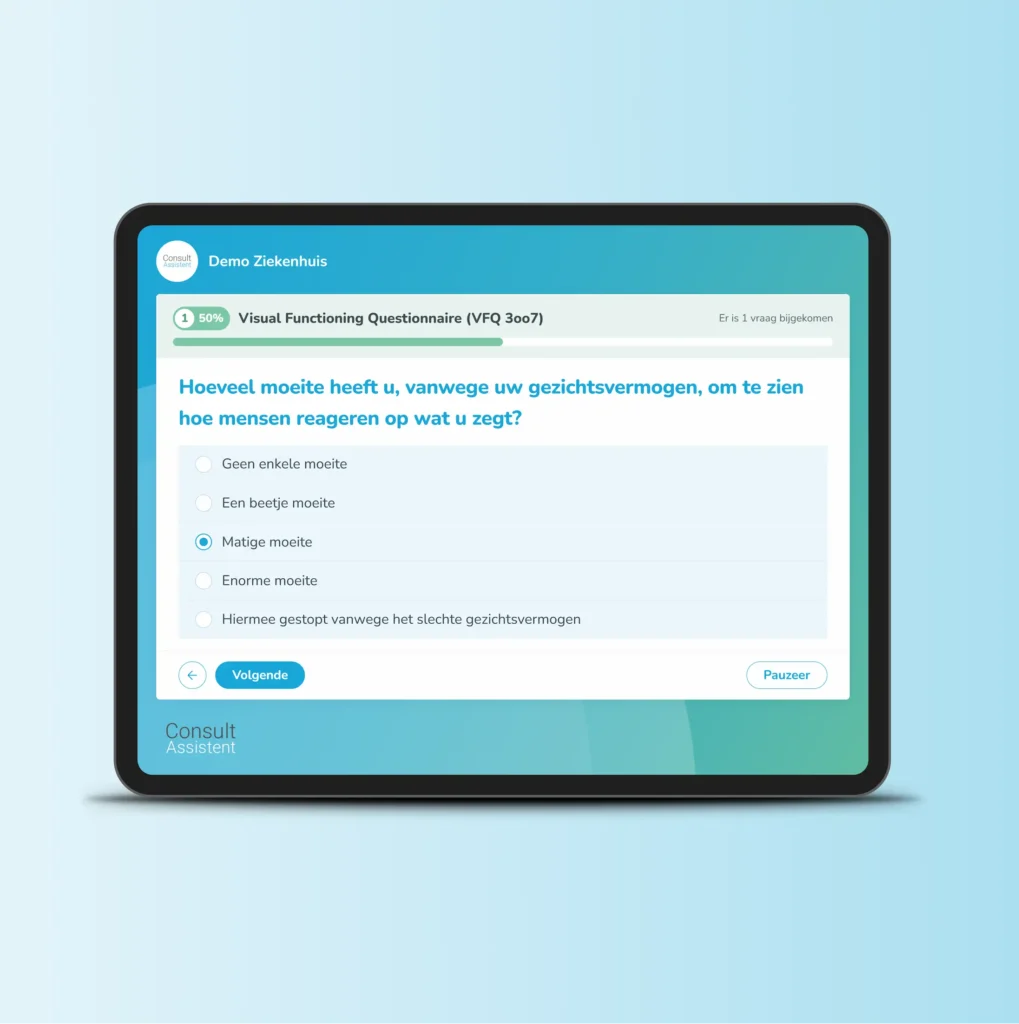
The ophthalmology module includes, among others:
- Catquest-9SF
- Visual Functioning Questionnaire (VFQ)
- AS-20
- Brief Impact of Vision Impairment
Is your preferred PROM questionnaire not listed here? If so, we can easily add it. The PROM questionnaires can be integrated into digital auto-anamnesis or the follow-up process, but they can also be sent separately at the right time—for example, before, during, and after treatments. This way, you'll always gather the right insights at the moments that really matter.
How does this benefit an ophthalmology practice?
- Spend less time on the initial anamnesis
- A better understanding of vision problems in advance
- More efficient consultations
- Improved monitoring of patients with chronic conditions
- Using follow-up appointments more effectively
- More time for diagnosis and treatment

FAQ about the ophthalmology module
How does digital auto-anamnesis help with ophthalmology consultations?
Patient information is collected in advance, allowing consultations to focus directly on assessment and treatment.
Is the ophthalmology auto-anamnesis suitable for older patients?
Yes, older patients also complete the questionnaires well, often with high response rates.
Which symptoms can be assessed digitally in the ophthalmology module?
These include decreased vision, double vision, flashes of light, redness, and irritation. The ophthalmology questionnaire is available to the entire patient population.
Can digital auto-anamnesis help with chronic care?
Yes, through follow-up and PROMs, changes in vision and symptoms can be monitored over time.
How are PROMs used in ophthalmology?
PROMs are used to measure visual acuity and quality of life before, during, and/or after treatment.
Related posts

Get in touch
Curious about how ConsultAssistent can help with consultation preparation in your ophthalmology department? Give us a call or send us an email. We’d be happy to work with you to develop your care pathway and workflow.