From fragmented data to actionable insight
In current practice:
- Data spread across different systems
- Measurements not always taken at the right moment
- Reporting takes manual work
- Trends and differences are hard to track
- Improvement measures are hard to substantiate
As a result, it's difficult for quality teams to build an up-to-date, coherent picture.
With ConsultAssistent:
- Outcome and experience measurements combined
- Patient information recorded in a structured way
- More insight into care outcomes
- Consistent data for analysis and reporting
- Relevant information before the care visit
See how ConsultAssistent can support your organization's quality policy.
Outcome measurements as part of quality policy
Quality teams use Patient-Reported Outcome Measures (PROMs) to measure symptoms, functioning, and outcomes from the patient's point of view. Patient-Reported Experience Measures (PREMs) give insight into patient experiences. ConsultAssistent sends out PROM and PREM questionnaires automatically at agreed moments, either as part of daily care or as a separate quality measurement. When measuring is built into daily care, response rates are higher, and the results carry more value both for the individual patient and for quality improvement.
The options include:
- Patient-Reported Outcome Measurements (PROMs)
- Patient Reported Experience Measures (PREMs)
- Measurement moments aligned with the care pathway
- Recording and logging of consent
- Additional questions tailored to local quality policy
Outcomes collected systematically within the care pathway
Improving quality takes consistent information, gathered the same way and at agreed moments. ConsultAssistent structures the responses so quality teams can track developments within comparable patient groups and care pathways. When making comparisons, differences in population, treatment, and context still matter.
For quality and safety departments, this makes the data useful for:
- More insight into care outcomes
- Comparison within patient groups and care pathways
- Substantiating improvement measures
- Reporting quality data to external bodies
- Discussions with the board and medical leadership
Relevant information before the care visit
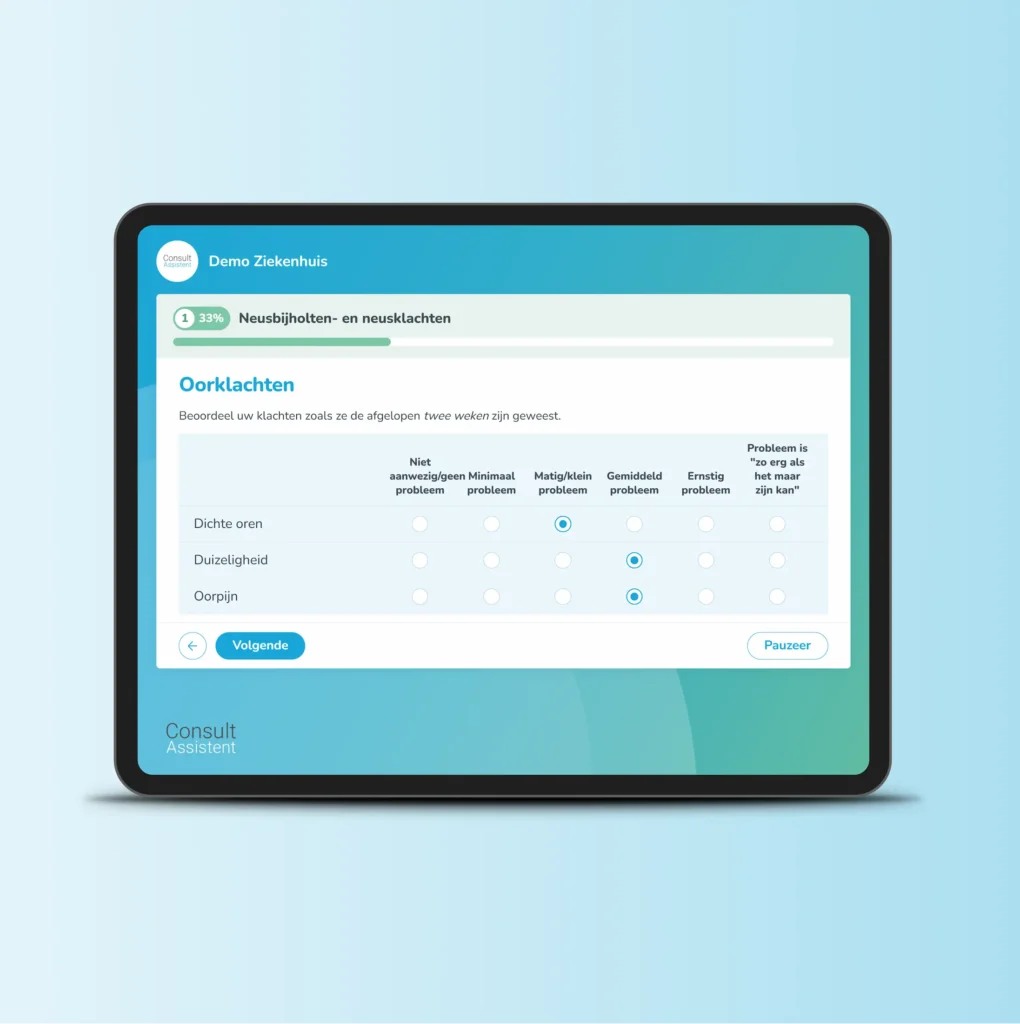
Safe care requires relevant safety information to be available before a consultation or procedure. Digital screening captures things like medication use, allergies, comorbidities, and previous complications. ConsultAssistent records these responses in a structured way and flags points of attention.attention.
For quality and safety departments, this means:
- Support for established work and safety procedures
- Safety information recorded consistently and in a structured way
- More insight into how care processes are carried out
- A starting point for analyzing and improving care processes
The healthcare organization decides how the collected information is used within its own safety procedures. Healthcare providers review the responses and remain responsible for how they're applied in care.
From data to insight and informed decisions
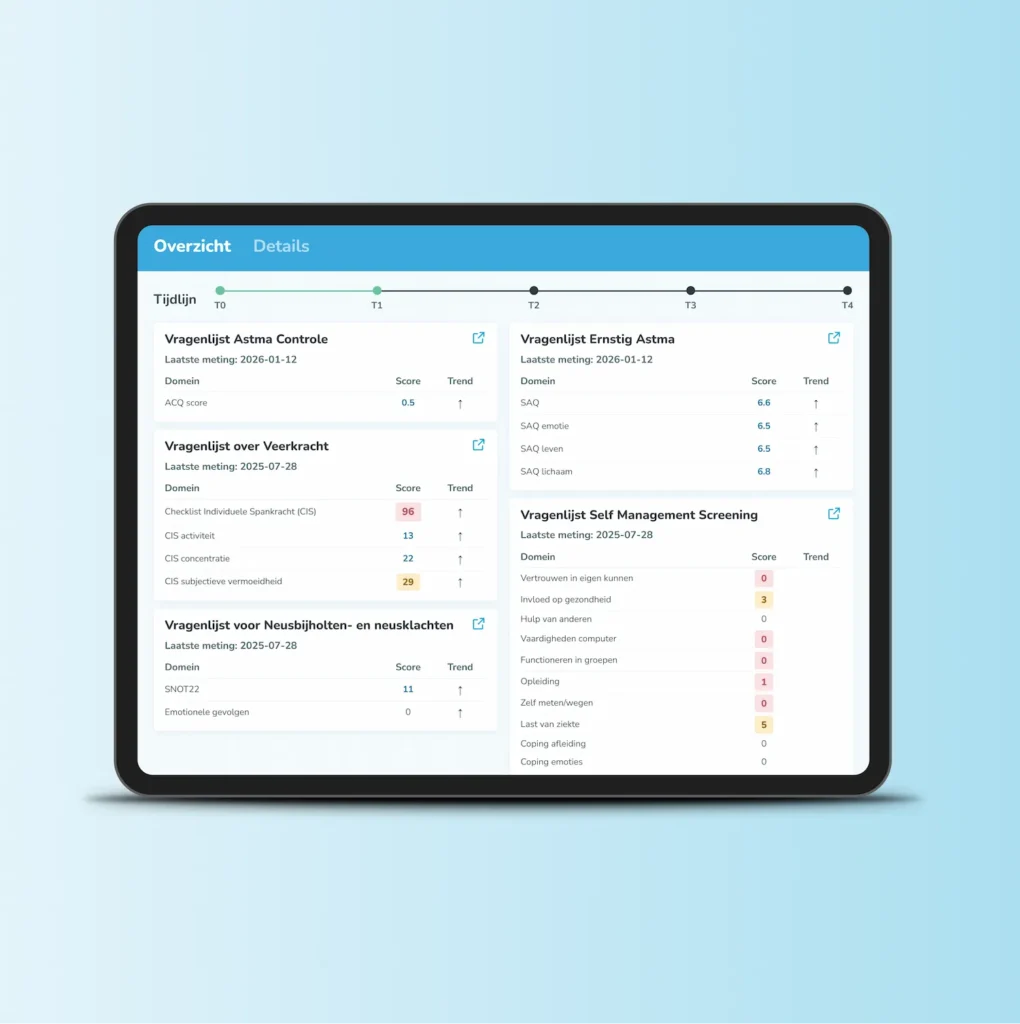
Quality teams want to do more than measure. They want to see where things are changing. ConsultAssistent makes outcomes visible on two levels.
At the patient level, the care team sees relevant responses and how they change over time. At the aggregated level, population dashboards show trends and differences within comparable patient groups and care pathways.
These insights can be used for:
- Policy development and management reporting
- Improvement cycles (PDCA)
- Benchmark information at the department or care-pathway level
- Evaluating treatment outcomes
Information for audits, site visits, and quality indicators
Systematically collected outcome data gives quality teams a better-substantiated basis for internal audits, site visits, quality indicators, and discussions with the board and medical leadership. Depending on how it's set up, the collected data can be used as input for quality reports. The healthcare organization sets the definitions, interprets the results, and remains responsible for the reporting.
From insight to targeted improvement
ConsultAssistent brings together care outcomes, patient experiences, and relevant safety information. This lets teams discuss areas for improvement, track measures, and assess progress. Book a demo to see how this fits your organization's quality policy.