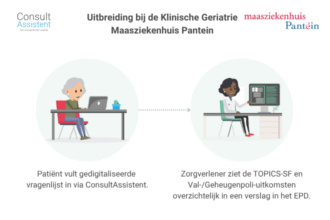
From fragmented information to a comprehensive patient profile
Practice in (clinical) geriatrics
In geriatrics, information is often spread across multiple sources:
- Multimorbidity and complex clinical pictures
- Polypharmacy and medication management
- Informal caregivers play an important role
- Information about a person's functioning and home situation is often lacking
- Extensive intake consultations
- Visiting the hospital in person is stressful
- Long-term follow-up and monitoring: functional status, risk of falls, cognitive function, and medication should be evaluated regularly
Geriatric Intake with ConsultAssistent
Geriatric intake appointments are becoming shorter thanks to better preparation for consultations:
- Complex information explained simply
- Medication use is known in advance
- The patient and caregiver fill it out together
- Information about health, functioning, and the home environment is collected in advance
- Shorter intake consultations
- An in-person consultation may not always be necessary
- Functional status, fall risk, cognitive functions, and medication are regularly assessed online
- Use follow-up appointments in a more targeted way
Geriatrics module
The geriatrics module supports, among other things:
- General medical history, including medical history and medication use
- Geriatric (rehabilitation) intake
The question structure adapts based on the answers provided and each patient's profile.
The care pathway for geriatric patients
ConsultAssistent supports the geriatrician before, during, and after the intake.
1
Before the consultation
The patient completes the digital intake form in advance, possibly together with a caregiver. This provides insight into the patient’s functioning, symptoms, and need for assistance.

2
During the consultation
The geriatrician has a structured overview of:
- Medical history
- Medication use
- Functioning and self-reliance
- Social context
- The request for assistance
This makes it possible to arrive at a comprehensive assessment more quickly.
3
After the consultation
Follow-up and outcome measures can be used to monitor changes in functioning, quality of life, and care needs.

Curious to know how this works in your geriatric practice?
Request a demoFrom isolated indicators to insights into vulnerability
In geriatrics, the focus is not just on individual symptoms, but on the interplay between physical, cognitive, and social factors. The digital intake brings these factors together and makes vulnerabilities and changes in functioning more apparent.
This provides advance insight into, for example, declining independence, quality of life, or an increased risk of falling. This helps focus the consultation on what is most relevant to this patient.
The data collected can be used in multidisciplinary consultations or to ensure that the rehabilitation process goes as smoothly as possible.

By listening carefully to the patient’s story and that of their loved ones, and by conducting a thorough examination, we gain a comprehensive understanding of the situation and identify what matters most to the patient. My patients’ responses to the ConsultAssistent digital questionnaire give me an initial impression of their symptoms, wishes, and goals prior to the first visit. We then explore these in greater depth during the visit.
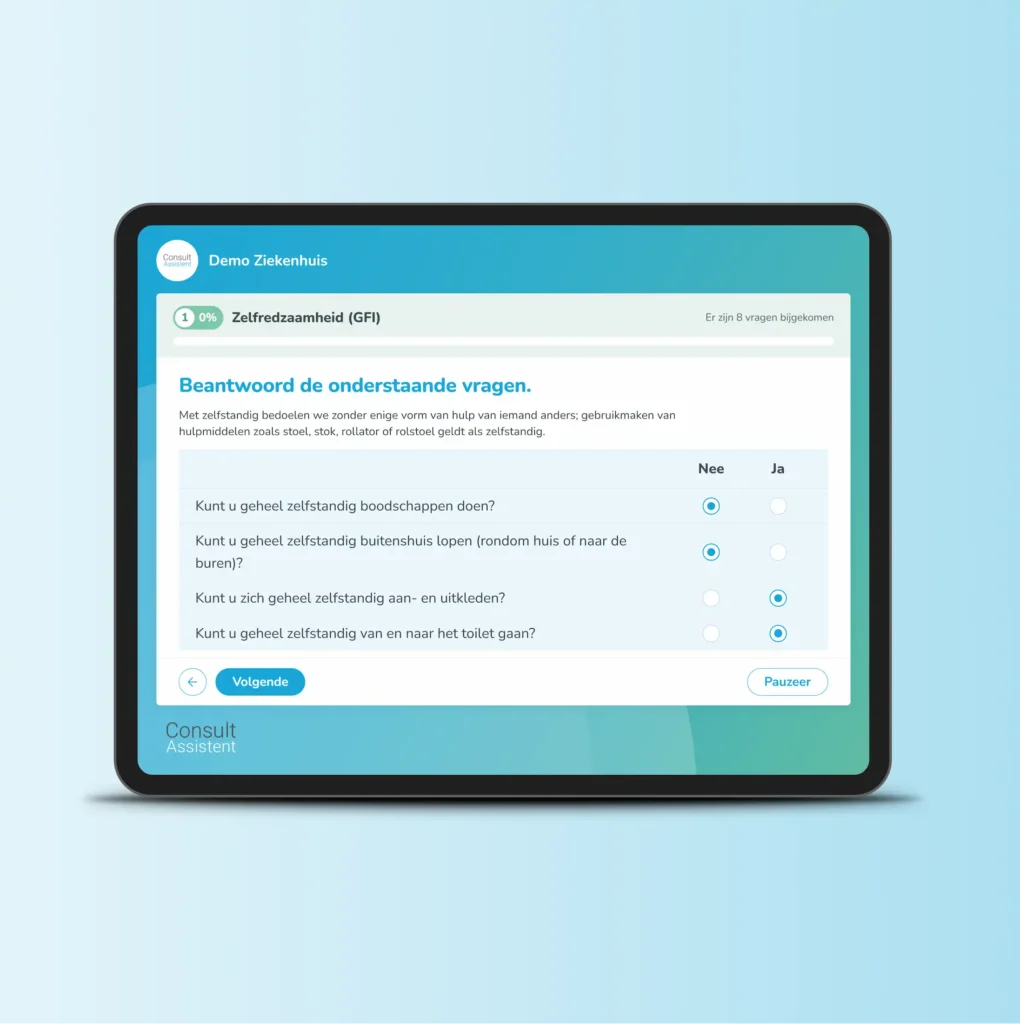
PROMs and outcome measures
in geriatrics
The geriatrics module includes the following:
- Groningen Frailty Indicator (Self-Sufficiency)
- Quality of life among older adults
- PROMIS
PROM questionnaires can be part of the digital auto-anamnesis or follow-up process, or they can be sent separately at an agreed-upon time. This provides the care team with information about symptoms and functioning when it is relevant. If the desired PROM questionnaire isn’t listed, we can easily add it.
How does this benefit geriatric practice?
- Spend less time on a detailed intake
- Greater involvement of patients and caregivers
- A better understanding of performance and context
- Consultations better tailored to the patient's needs
- Reduced burden through more targeted hospital visits
- More efficient consultations
- Improved monitoring of vulnerability

FAQ about the geriatrics module
How does a digital intake help with geriatric consultations?
Information about health, functioning, and social context is gathered in advance, allowing consultations to begin immediately with a complete picture.
Can informal caregivers be involved?
Yes, informal caregivers can help fill out the questionnaire to provide a more complete picture of the patient.
How is performance measured?
Through questions about self-reliance, daily functioning, and quality of life, possibly supplemented with PROMs.
How are PROMs used in geriatrics?
PROMs are used to measure functioning, vulnerability, and quality of life over time.
Related posts

Get in touch
Curious about how ConsultAssistent can help with consultation preparation in your geriatrics department? Give us a call or send us an email. We’d be happy to work with you to develop your care pathway and workflow.