From time-consuming anamnesis to targeted diagnostics
Practice at the neurology outpatient clinic
There are several challenges within the neurology practice:
- Complex diagnostics involving many variables
- A long and time-consuming anamnesis
- Symptoms that are difficult to organize
- Many follow-up visits are needed
- Increasing wait times
- High workload for healthcare providers
It is difficult to properly prioritize referrals without a full understanding of the symptoms and the course of the condition.
Using digital auto-anamnesis in ConsultAssistent
Better consultation preparation with the neurology auto-anamnesis:
- Enrichment of referral information
- Consultations are more focused and efficient from the start
- Less time needed for a comprehensive anamnesis
- Use follow-up appointments in a more targeted way
- A better understanding of the course and severity of symptoms
- Support with triage
Learn more about ConsultAssistent's digital auto-anamnesis.
Initial complaints in the neurology auto-anamnesis module
Currently, the module supports the following initial complaints:
- Dizziness
- Hernia (HNP)
- Headaches (in development)
- Parkinson's (via PROMs)
The questions adapt based on previous answers, so that only relevant information is requested.
Digital auto-anamnesis for neurology
In neurology, diagnosis revolves around recognizing patterns in symptoms, disease progression, and context. Digital auto-anamnesis provides this information in advance. This helps speed up the diagnostic process and make consultations more targeted.
Patients provide information about:
- Course and cause of symptoms
- Medication use
- Neurological history and risk factors
- Family history
- Warning signs
- The patient's presenting concern
In addition, the symptom burden is recorded using measures such as VAS scores, which makes it easier to compare and monitor symptoms.
The neurology care pathway
ConsultAssistent supports the care pathway before, during, and after the consultation.
Before the consultation
The patient completes the auto-anamnesis in advance based on the reason for referral. This provides an overview of the patient's symptoms, progression, risk factors, and medication use.

During the consultation
The neurologist has a structured overview of:
- Presenting concern
- Symptoms and patterns
- Medication use
- Risk profile
In addition, a concise AI-generated medical summary is created, which helps the healthcare provider quickly grasp the essence of the patient’s symptoms and use it during the consultation. Thehealthcare provider reviews the AI summary and remains responsible for documentation and decision-making.

After the consultation
Follow-up and outcome measures are used to monitor the progression of symptoms and identify changes in a timely manner.
Curious to know how this works in your neurology practice?
Request a demoFrom consultation to continuous monitoring of symptoms
Neurological conditions often require long-term follow-up. With digital follow-up, patients are automatically prompted to report changes in their symptoms, such as:
- Progression of existing symptoms
- Effect of treatment
- New symptoms
The care team uses this information to track symptoms over time, assess follow-up visits more effectively, and discuss changes in a timely manner. By systematically documenting symptoms and their progression, insights into patterns at the population level are also gained, which can contribute to improvements in diagnostics and treatment strategies.
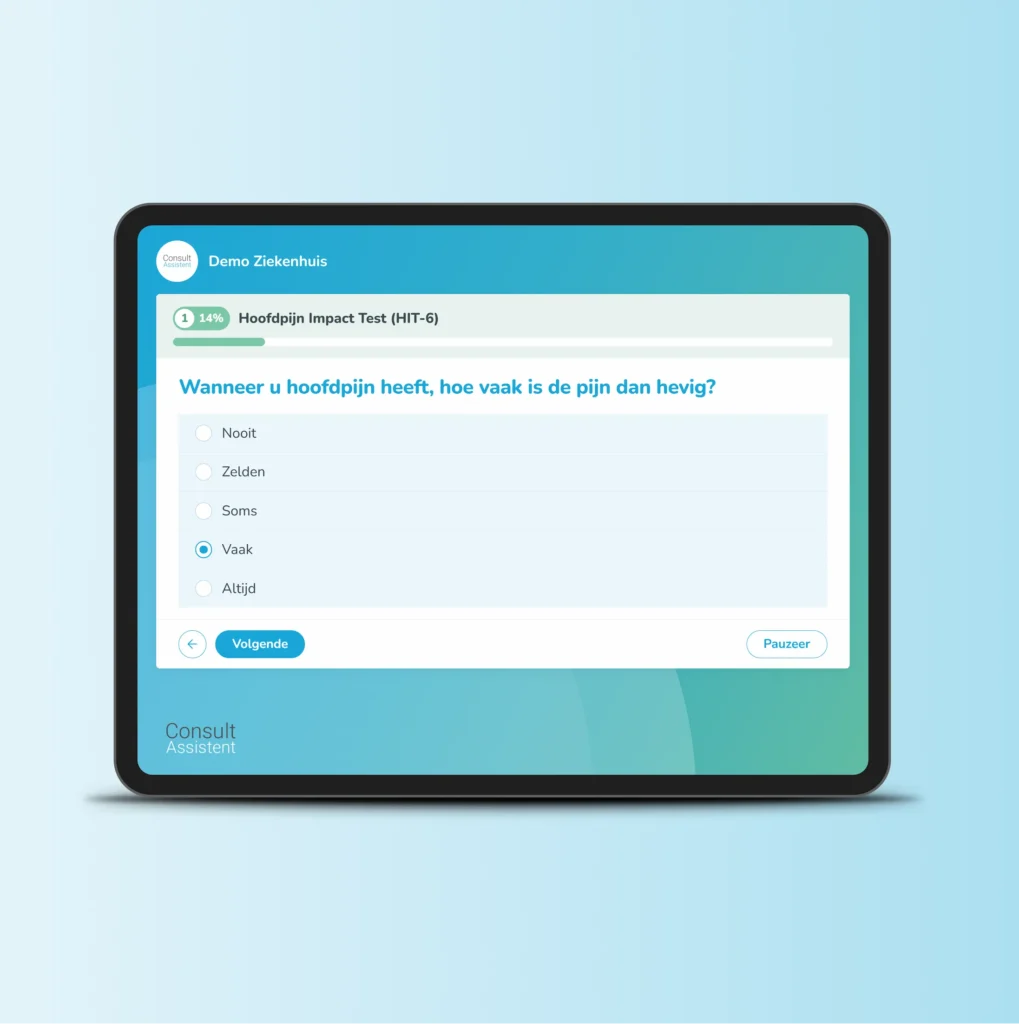
PROMs and outcome measures in neurology
The neurology module includes, among other things:
- Dizziness Handicap Inventory (DHI)
- Headache Impact Test (HIT-6)
- Hospital Anxiety and Depression Scale (HADS)
- Parkinson’s Disease Questionnaire (PDQ8)
- ICHOM questionnaires (including those on dementia and stroke)
Is your preferred PROM questionnaire not listed here? If so, we can easily add it. The PROM questionnaires can be integrated into digital auto-anamnesis or the follow-up process, but they can also be sent separately at the right time—for example, before, during, and after treatments. This way, you'll always gather the right insights at the moments that really matter.
How does this benefit the neurology practice?
- Spend less time on a detailed anamnesis
- Faster insight into symptoms and the course of the illness
- More efficient consultations
- Improved monitoring of chronic symptoms
- Use follow-up appointments in a more targeted way
- Better support for diagnostics

FAQ about the neurology module
How does digital auto-anamnesis help with neurological consultations?
Patient information is collected in advance, which reduces the time needed for the anamnesis and allows the consultation to focus directly on diagnosis.
Why is the digital auto-anamnesis particularly important in neurology?
Because symptoms are often complex, and recognizing patterns and the course of the condition is essential for diagnosis.
How does ConsultAssistent support follow-up care?
ConsultAssistent sends follow-up questions at agreed times along the care pathway. The questions build on previous answers, and patients who don't respond automatically receive a reminder. Through the EMR integration, the care team can view the responses within their existing workflow.
Which symptoms can be assessed digitally in the neurology module?
These include dizziness, herniated discs, and headaches (under development). The neurology module is currently being expanded so that it can be used for the entire patient population.
How are PROMs used in neurology?
PROMs are used to measure and monitor symptoms, functioning, and quality of life.
Get in touch
Curious to learn how ConsultAssistent can help with consultation preparation in your neurology department? Give us a call or send us an email. We’d be happy to work with you to develop your care pathway and workflow.