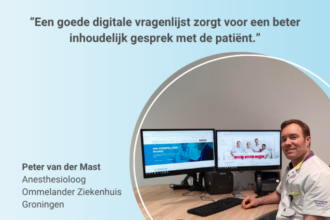
From routine questions to targeted preparation
Current practice in anesthesiology
- Routine questions take up consultation time
- Information is scattered throughout the EMR
- Limited insight into the choice of consultation format
- Limited overview for pre-triage
- Capacity is difficult to estimate in advance
This takes time during the consultation and makes it more difficult to schedule in-person and remote consultations.
Preoperative screening with ConsultAssistent
- Medical information collected in a structured manner
- Answers neatly organized by topic
- Information to help you choose the type of consultation
- A standard inquiry within the agreed-upon care pathway
- A clear starting point for triage and planning
The preoperative team reviews the information. The treating anesthesiologist remains responsible for the risk assessment and determining the appropriate form of consultation (in person, by phone, or online).
Supported screening modules
The anesthesia module supports, among other things:
- Preoperative Screening (POS)
- Screening for Oral and Maxillofacial Surgery (OMFS)
- Pre-MRI screening
- Screening for endoscopy
The modules are tailored to the specific care pathway.
Structured information for risk assessment and determining the most appropriate form of consultation
Before the consultation, the anesthesiologist needs a comprehensive overview of the patient’s medications, allergies, medical history, and risk factors. ConsultAssistent collects this information in advance using a standardized format and compiles the responses into a structured report. This way, the healthcare provider does not have to ask these routine questions during the consultation and does not have to piece together scattered data from the EMR.
The report presents the answers in a fixed format. When linked to the EMR, the report becomes immediately available in the EMR. The preoperative team reviews the information. The attending anesthesiologist remains responsible for the risk assessment and the type of consultation.
Using this overview, the preoperative team assesses:
- Whether the patient needs to be seen in person
- Whether a telephone consultation or a fully digital consultation is sufficient
The screening provides valuable input for determining the ASA classification and the format of the perioperative consultation. The preoperative team can review this information before the consultation. The structured patient information also supports coordination between anesthesiology, surgery, and OR scheduling.
From screening to surgery: targeted preparation
Preoperative preparation tailored to the patient and the procedure.
1
Digital preoperative screening
Before the procedure, the patient receives a digital preoperative screening. At home and at their own pace, the patient answers questions about their medical history, medications, allergies, and risk factors.

2
Assessment by the preoperative team
The preoperative team reviews the relevant data in a structured report and determines what preparations and types of consultations are needed:
- An in-person consultation
- A telephone consultation
- A fully digital consultation

3
Targeted preparation for surgery
After the evaluation, the patient receives appropriate information and instructions. The anesthesiologist has the relevant medical information at their disposal. This ensures that the surgical process begins with thorough preparation.

Curious about how this works at your anesthesia clinic?
Request a demo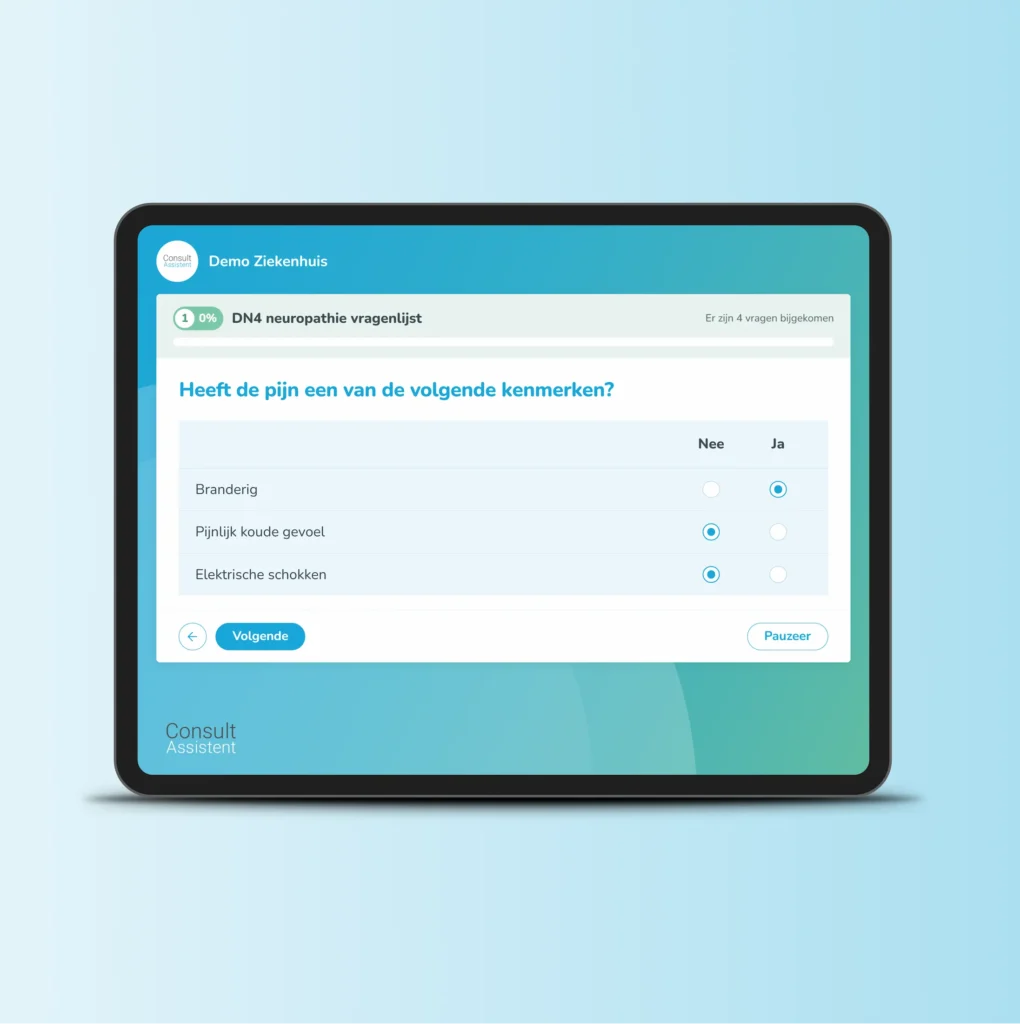
PROMs and monitoring in anesthesia
Various Patient-Reported Outcome Measures (PROMs) are available for pain management in anesthesiology, including:
- PROMIS Pain
- Neuropathic Pain and 4 Questions (DN4)
- Neck Disability Index (NDI)
- Multidimensional Pain Inventory – Dutch Language Version (MPI-DLV)
PROM questionnaires can be part of the screening or follow-up process, or they can be sent separately at an agreed-upon time. This provides the care team with information about symptoms and functioning when it is relevant. If the desired PROM questionnaire isn’t listed, we can easily add it.
What are the practical benefits of this?
- More consultation time for unusual answers
- Less time spent searching for individual patient information
- A clearer starting point for choosing the consultation format
- A standardized information base for preoperative triage
- Clear information to ensure coordination throughout the surgical process

FAQ about the anesthesia module
How does ConsultAssistent help with preoperative screening?
Before a procedure, patients complete an online questionnaire about their health, medications, and risk factors. ConsultAssistent compiles the answers into a structured report. The anesthesiologist uses this information to assess the preparation and determine the appropriate consultation format.
Can digital preoperative screening help with triage?
Yes. The screening provides the preoperative team with insight into the medical responses prior to the consultation. The team reviews the information; the treating anesthesiologist remains responsible for the risk assessment and the type of consultation.
Can consultations be conducted remotely?
Yes, if the care team deems it appropriate. ConsultAssistent presents the medical answers in a structured format. The team reviews this information and determines which type of consultation is needed. The treating healthcare provider remains responsible.
How is information processed in the EMR?
Once an EMR integration has been set up, ConsultAssistent processes the responses into a structured report that is immediately available in the EMR. The care team reviews the content.
Related posts

Get in touch
Curious about how ConsultAssistent can help with preoperative screening in your anesthesiology department? Give us a call or send us an email. We’d be happy to work with you to develop your care pathway and workflow.