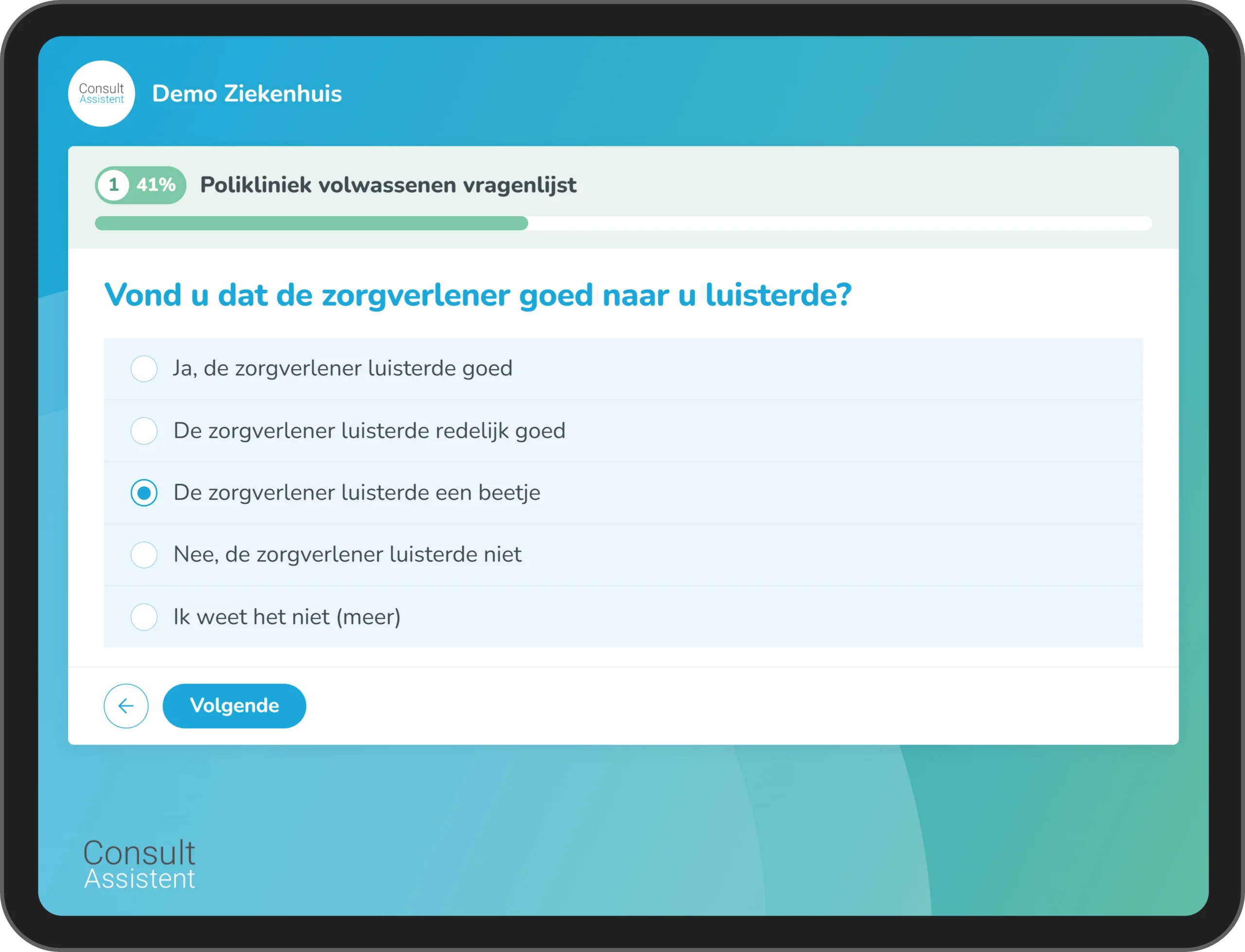
What are PREMs and experience measurements?
PREMs (Patient-Reported Experience Measures) are digital questionnaires patients use to report on how they experienced their care. They cover things like communication, the way they were treated, information, and follow-up care: did the patient feel heard, understood, and well-informed?
PREMs measure experiences with care, not its medical outcome. They complement clinical data and Patient-Reported Outcome Measures (PROMs). This shows what matters to patients, and where communication, guidance, or organization could improve.
Why patient experiences often go underused
Measuring patient experiences in practice
Healthcare organizations measure patient experiences, but the results don't always reach the care team or daily practice.
- Measurements sit apart from the care pathway
- PROMs and PREMs are often in separate systems
- Results rarely translate into improvement actions
- Response rates vary, or the measurement is a one-off
- Results sit apart from other measurements
This leaves valuable experiences underused, and the care team without concrete input for improving care and communication.
Measuring patient experiences with ConsultAssistent
ConsultAssistent makes collecting and using patient experiences part of the care pathway.
- PREMs align with the care pathway
- Invitations are sent automatically
- Results are available to the care team
- Patients get a targeted survey
- Dashboards show trends and patterns
This lets healthcare providers and quality teams discuss experiences with purpose, and use them to improve care and communication.
USING PATIENT EXPERIENCES
From feedback to concrete areas for improvement
ConsultAssistent processes responses into a dashboard of experiences and trends. Depending on the setup, healthcare providers and quality teams can see what patients are happy with and where attention is needed. They use these insights to improve communication, information, and care processes.

We discuss the results of the anonymous satisfaction surveys as a team every quarter. The charts in the dashboards allow us to effectively track trends and implement improvements in the quality of care more quickly.
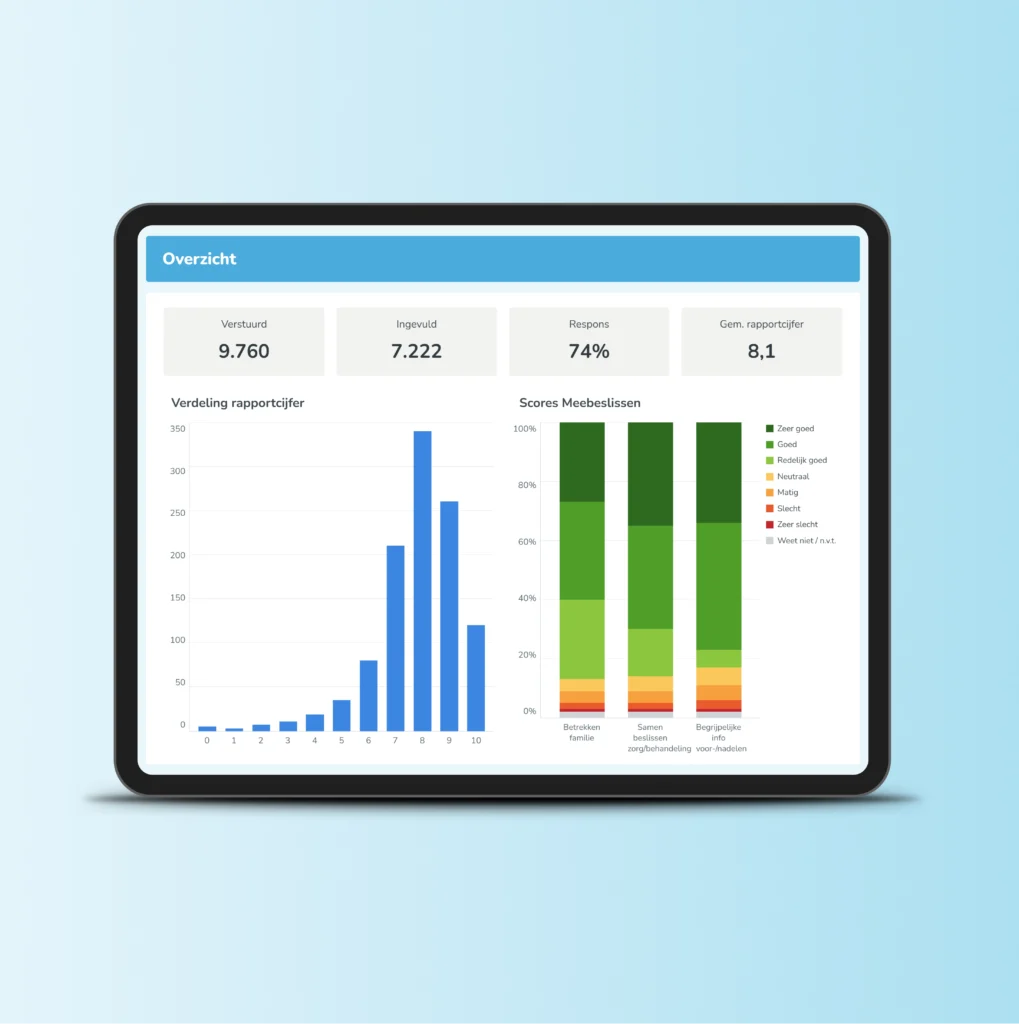
High response rate, relevant feedback
Reliable insights depend on patient participation. ConsultAssistent gets a very high response rate.
This results in:
- Comprehensive feedback, including from less vocal patients
- Greater representativeness of the results
- Immediately actionable insight for care teams
Less manual work for the IT department
ConsultAssistent handles the entire digital PREMs process, from setup to survey and insight.
This makes it possible to:
- Invite patients automatically
- Align PREM questionnaires with the care pathway
- Send reminders automatically
- Reduce manual work around the survey process
ConsultAssistent also offers the ability to:
- Organize PROMs and PREMs within a single workflow
- Add your own questionnaires
- Track results over time in dashboards
- Make results available for quality meetings
What benefits do digital PREMs offer your healthcare organization?
- Understanding how patients experience care
- Concrete areas for improvement for the quality meeting
- Insights for quality policy and accountability
- Better aligning care with expectations
- Fewer manual invitations and reminders

FAQ about digital PREMs
Can a patient complete a PREM anonymously?
That depends on the chosen setup. With an anonymous survey, the care team only uses group-level results that can't be traced to one patient. Individual responses aren't meant to be used in conversations with a specific patient.
When are PREMs sent out?
ConsultAssistent sends out PREMs at preset moments, for example after a consultation or treatment.
How does the care team use PREMs in practice?
ConsultAssistent processes the results into dashboards and summaries. Healthcare providers and quality teams discuss the trends and choose areas for improvement in care and communication.
Get in touch
We're glad you're interested in ConsultAssistent. Do you have a question? Please contact us. You can reach us by phone or send us an email. We'd be happy to help you.